Episode 66 · 14:08
OSCE Practice Case: Chronic Back Pain, Low Mood and the Boom-Bust Cycle.
"A simulated OSCE station with an AI patient: Warren, 52, has persistent low back pain, a boom-bust activity pattern and low mood, and has stopped his exercises. Watch hurt vs harm, pacing and a gentle reframe delivered in one session, then run the same station yourself with the free prompt and study pack."
Run this station yourself
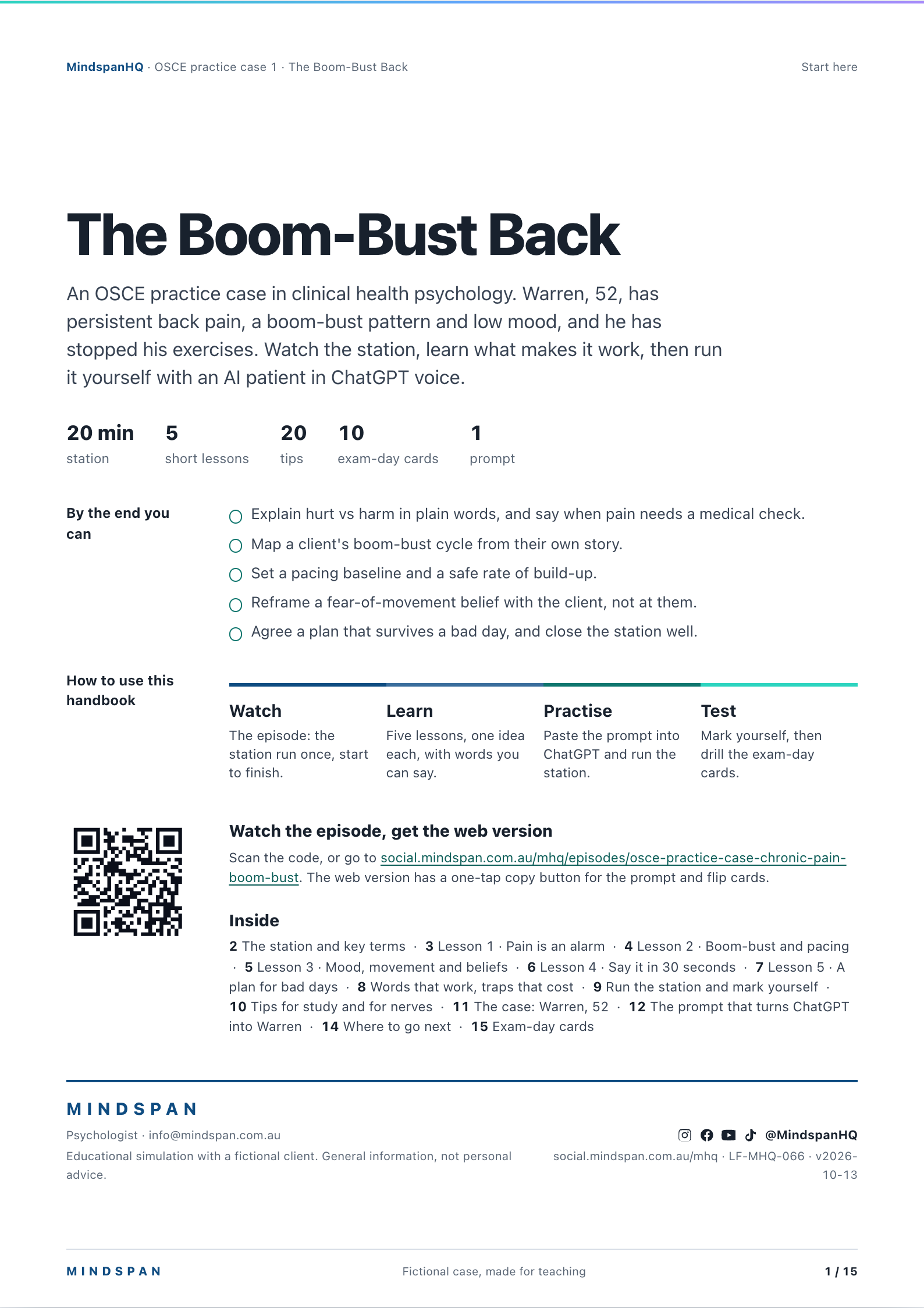
The free handbook behind the episode: 15 pages, the exact ChatGPT voice prompt, no sign-up.
- Study notes: hurt vs harm, pacing, reframes, phrase bank
- Station flow and a marking self-check
- 10 study tips + 10 tips for exam nerves
- The case and its clinical map
- The ChatGPT voice prompt
Practise with ChatGPT voice
Three steps
- Open ChatGPT (app or web) and start a new chat. Paste the whole prompt and send it as a normal text message.
- Tap the voice button (the sound-wave icon). In ChatGPT, go to Settings, then Voice, and pick a deeper, male-sounding voice. Headphones stop it hearing itself.
- Set a 20-minute timer, greet Warren and run the station. Say "End of station" to finish, then "Examiner feedback" for a debrief.
What this prompt does
- Asks ChatGPT to play Warren, 52, a made-up client, so you can practise the psychologist's role out loud.
- Keeps the role-play in character until you say
End of station
. Then, only if you ask forExaminer feedback
, it gives a short debrief. - Contains no personal data and sends nothing anywhere. It is plain text you paste in yourself.
Practice only. Never type in real client details. It is not therapy and not clinical advice.
Go further
- Full programMindspan OSCE Psychology Exam PrepStructured preparation for the psychology OSCE. Free test-drive.
- FreeClinical health psychology previewFree. The health-formulation track this case is drawn from.
- FreeOSCE free sampleFree. A short video, an audio walkthrough and the OSCE Navigator PDF.
- In developmentOSCE Live CompanionIn development. Practise stations with live transcription and prompts on your own device.
- Free seriesOSCE Psychology Exam SkillsFree MindspanHQ series. This case is part 1; more short lessons on station skills follow.
Resources mentioned
- Raja, S. N., et al. (2020). The revised International Association for the Study of Pain definition of pain. Pain, 161(9), 1976–1982.
- Vlaeyen, J. W. S., & Linton, S. J. (2000). Fear-avoidance and its consequences in chronic musculoskeletal pain. Pain, 85(3), 317–332.
- Andrews, N. E., Strong, J., & Meredith, P. J. (2012). Activity pacing, avoidance, endurance, and associations with patient functioning in chronic pain. Archives of Physical Medicine and Rehabilitation, 93(11), 2109–2121.
- Moseley, G. L., & Butler, D. S. (2017). Explain Pain Supercharged. NOI Group.
- Nicholas, M., Molloy, A., Tonkin, L., & Beeston, L. (2011). Manage Your Pain (3rd ed.). ABC Books.
- Martell, C. R., Dimidjian, S., & Herman-Dunn, R. (2010). Behavioral Activation for Depression: A Clinician's Guide. Guilford Press.
Take-aways
01Pain is real, and it works like an alarm.
Pain is made by the nervous system to protect us. In persistent pain the alarm becomes over-sensitive, so it goes off early and loudly even after the tissues have healed. The pain is real. It is not 'in his head'. It is just no longer a reliable damage meter.
02Hurt is not the same as harm.
Not all pain is equal. Some pain is feedback from muscles that are out of condition and a sensitive system. It is uncomfortable, but it is not damage. Other pain is a warning that needs a medical check. Teach him the difference (see the table below), so he can keep moving with confidence.
03Boom-bust keeps the pain loud.
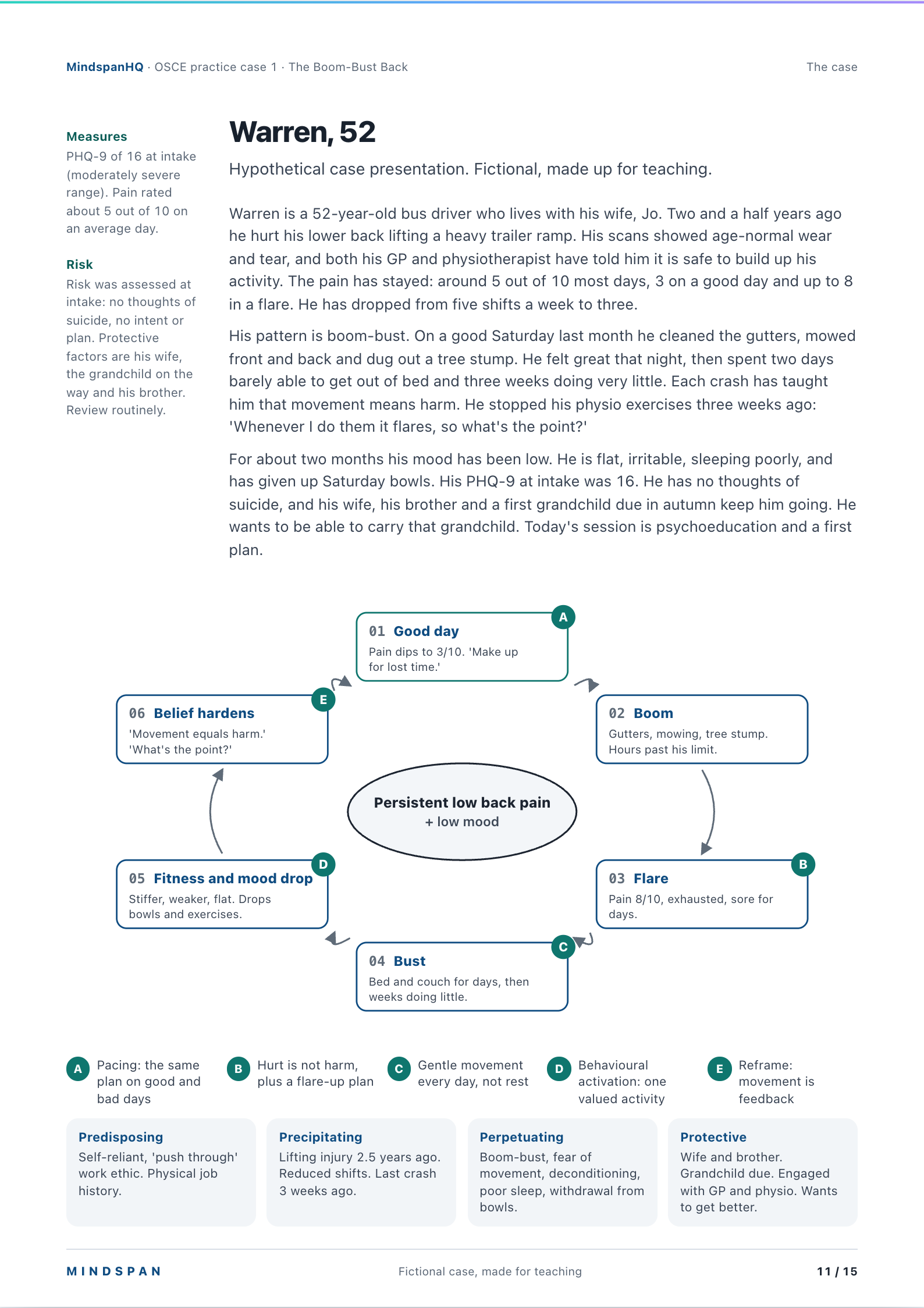
Overdoing it on a good day leads to a flare, then rest, then lost fitness. The next good day comes with less fitness, so the crash comes sooner. Each crash teaches 'movement equals harm', and the weeks of inactivity feed the low mood.
04Pacing: plan, not pain.
Pacing means doing a steady amount every day, set by a plan and a timer, not by how the pain feels in the moment. Start below his limit, keep it the same on good and bad days, and build up slowly.
05Mood and movement feed each other.
Pain and depression share a loop. Less activity means less enjoyment and achievement, which means lower mood and less energy to move. Behavioural activation breaks it: schedule one small, valued activity, and do it before motivation arrives. Motivation tends to follow action.
06Reframe gently, with his evidence.
Don't argue with the belief. Get curious about it. Ask what else the pain after movement could mean, what his GP and physio found, and what happened on days he did a little instead of a lot. Then offer the alternative in his own words.
This is general mental-health education, not personal clinical advice — it is no substitute for assessment by a registered health practitioner, and discusses persistent pain and low mood. If you need support now, contact Lifeline 13 11 14, call 000 in an emergency, or speak with your GP.