Episode 70 · ~12:00
UpcomingNotes and sources are up; the episode hasn't aired yet. Subscribe to stay up to date.
OSCE Practice Case: Functional Symptoms and Attention Retraining.
"A simulated OSCE station with an AI patient: Bobby, 25, uses they/them and was diagnosed with functional tics and functional motor symptoms four months ago. They watch their body all day, try to hold the movements in, and have pulled back from the climbing gym, friends and live music. Watch attention explained as a spotlight and three retraining techniques trialled in one session, then run the same station yourself with the free prompt and study pack."
Run this station yourself
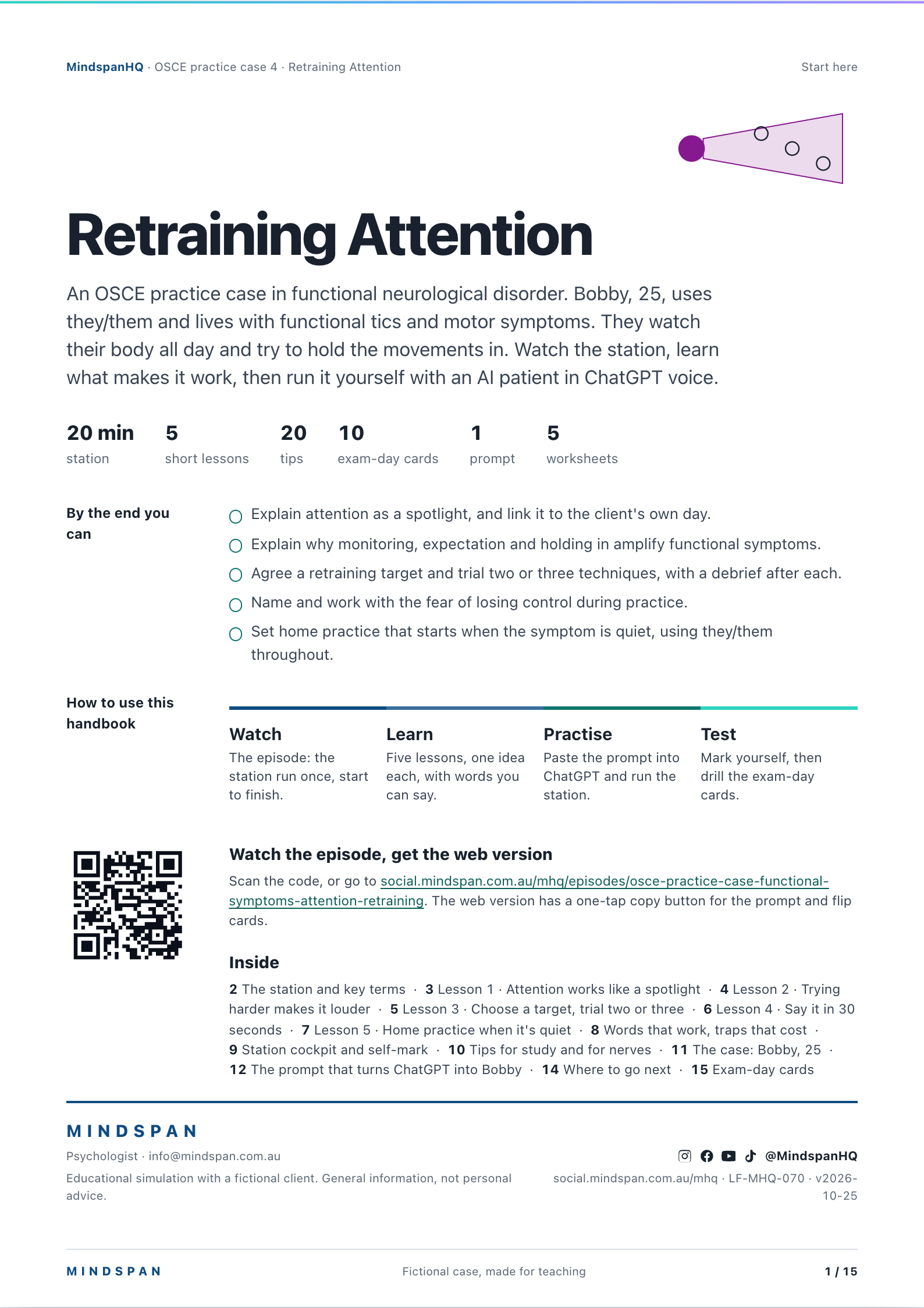
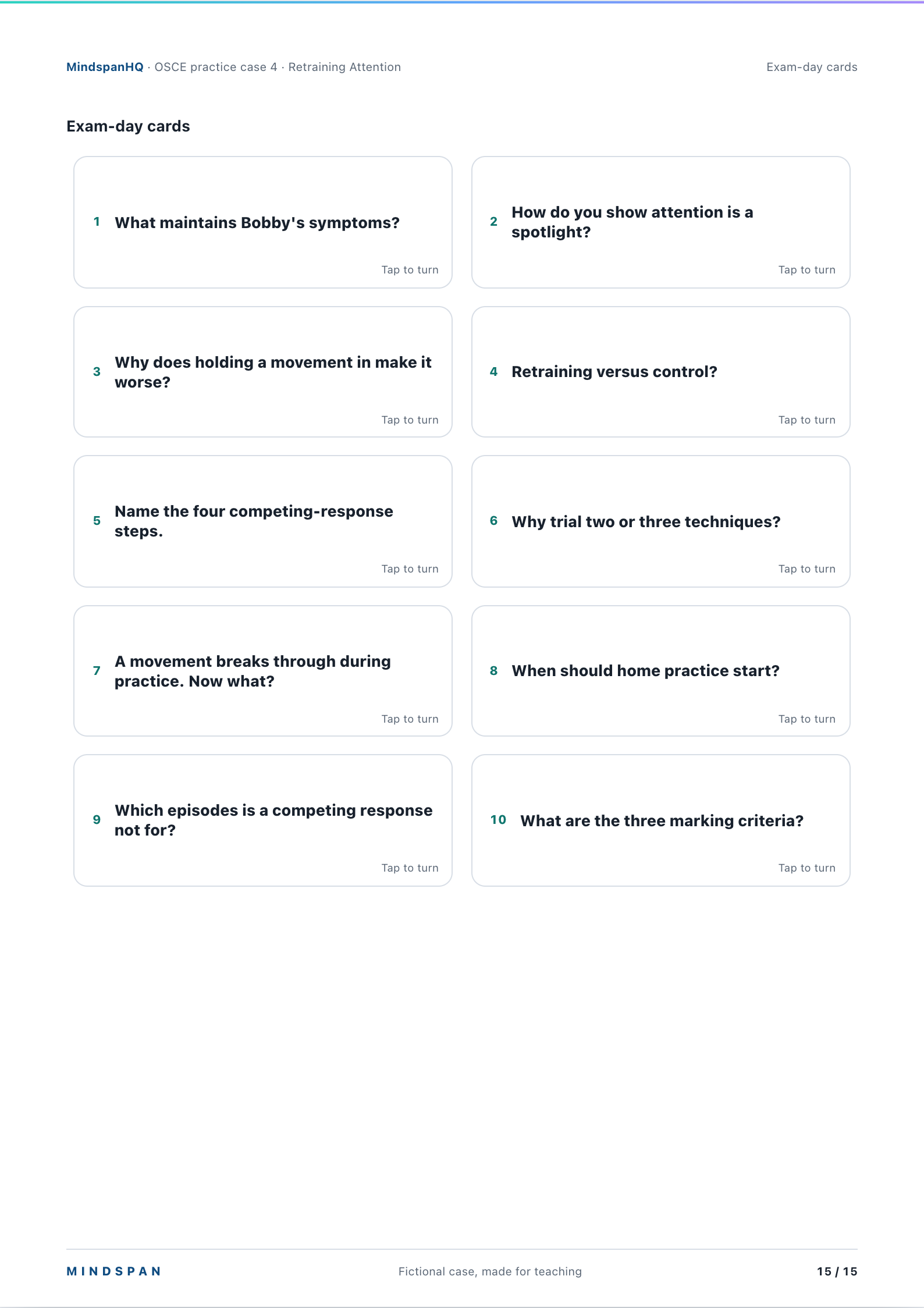
The free handbook behind the episode: 15 pages, the exact ChatGPT voice prompt, no sign-up.
- Study notes: the attention spotlight, why holding in turns it up, three techniques, phrase bank
- The station cockpit: segments, example lines, rubric self-mark
- 10 study tips + 10 tips for exam nerves
- 5 worksheets, blank and filled in
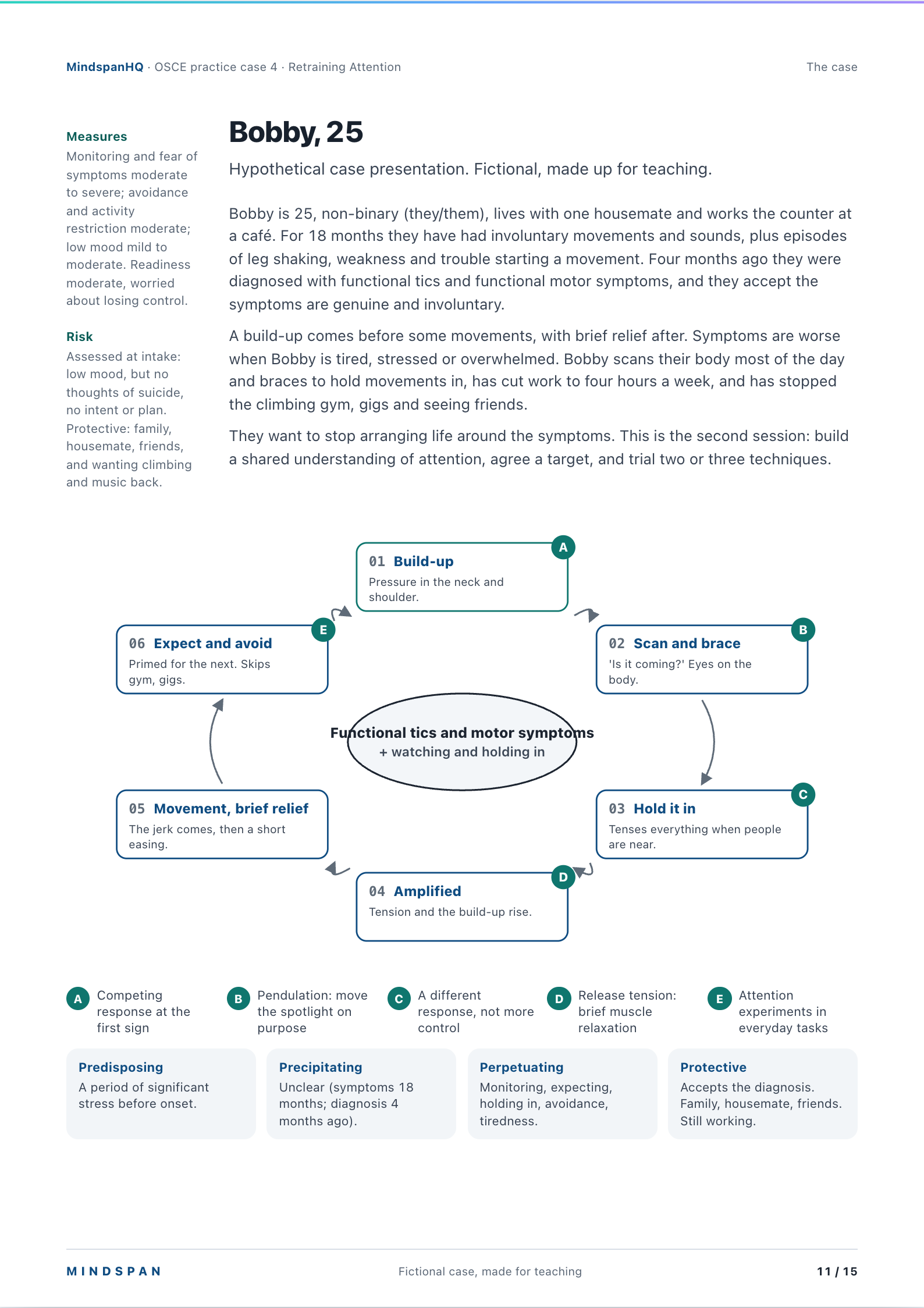
- The case and its clinical map
- The ChatGPT voice prompt
Sheets for this station
Free to download and print. Each worksheet comes blank, with room to write, and filled in as Bobby would fill it in.
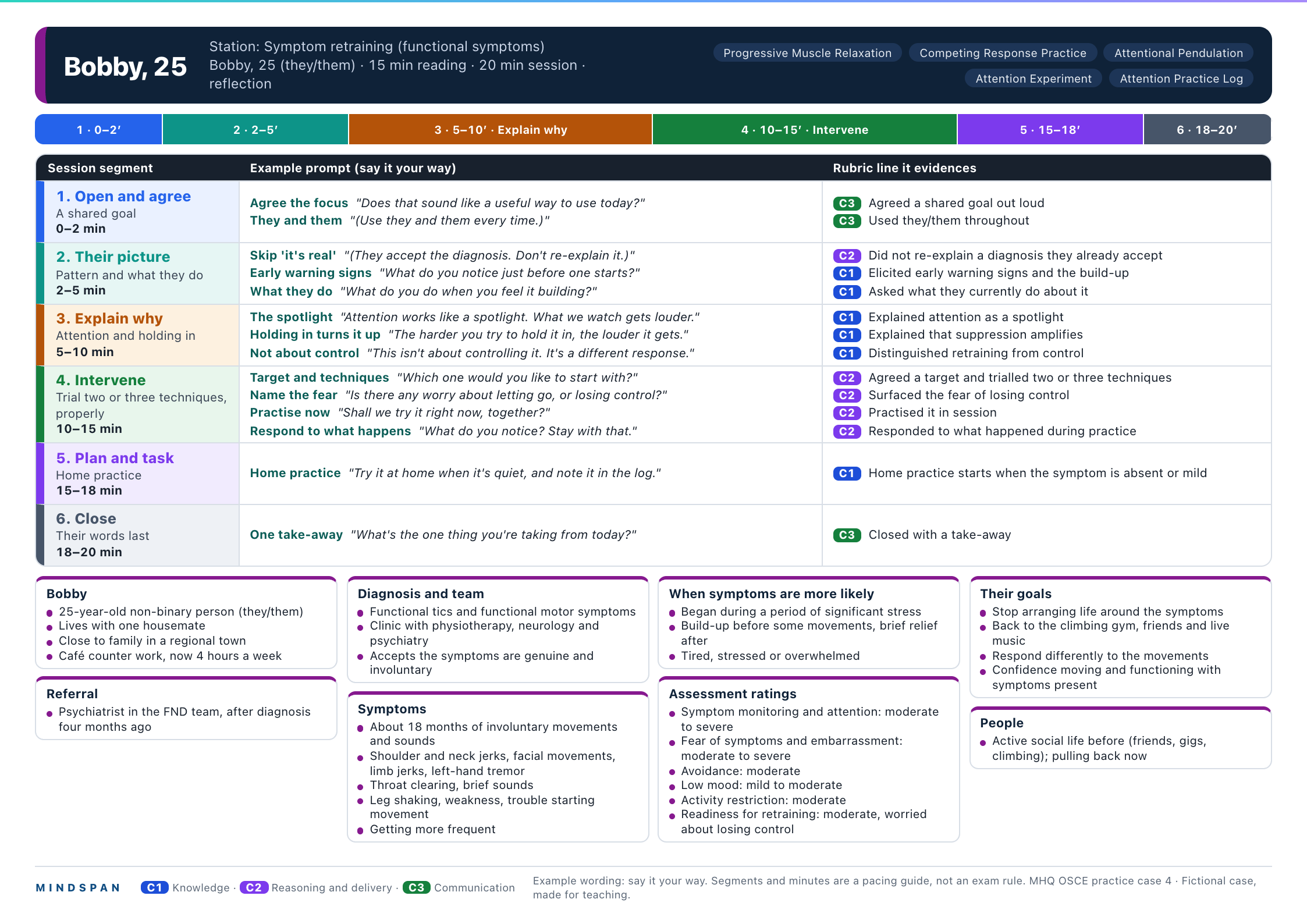 Station cockpitThe whole station on one landscape page: six segments, an example line for each move, and the rubric line it evidences. Download the cockpit
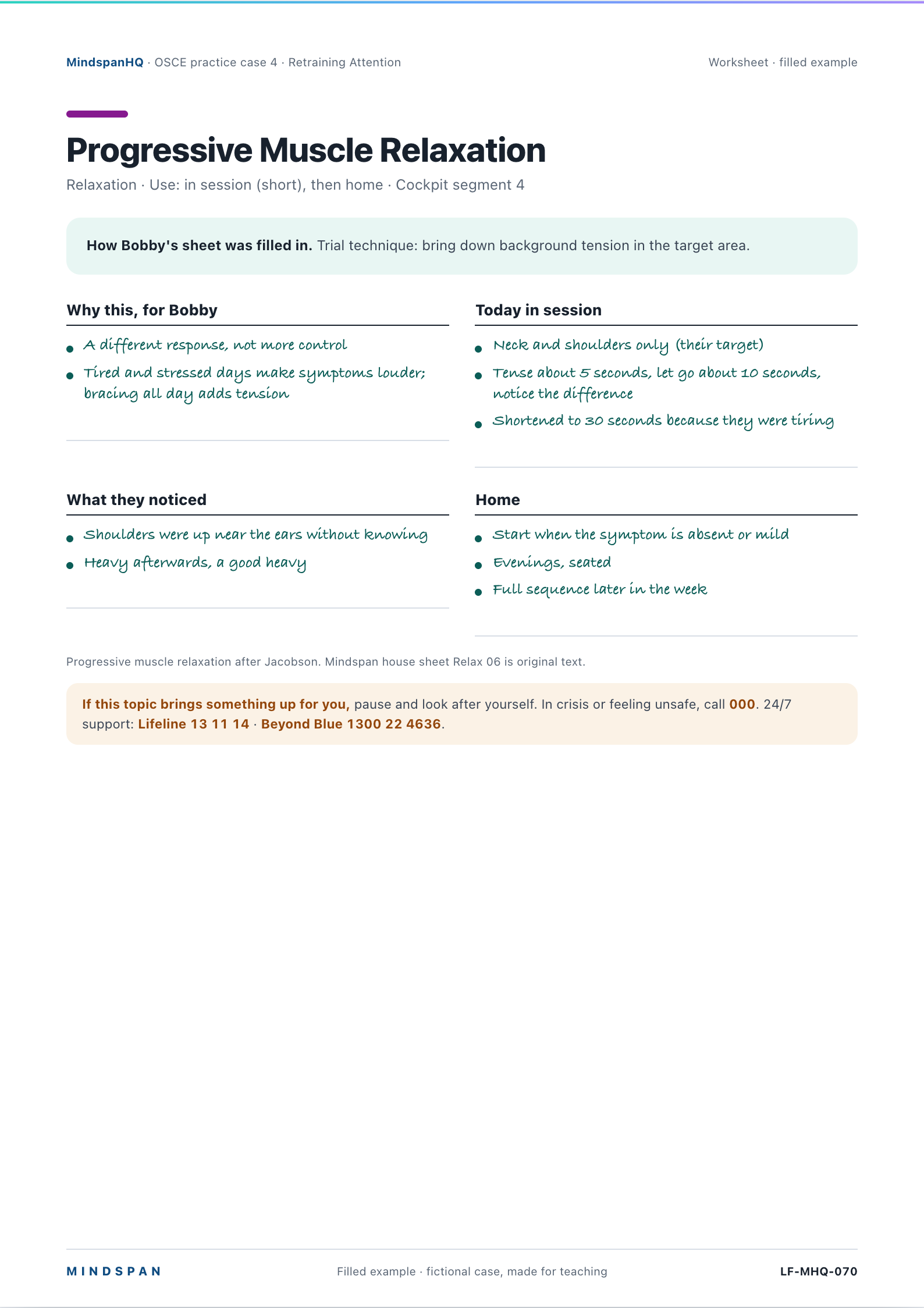 Progressive Muscle RelaxationRelaxation Blank Filled example
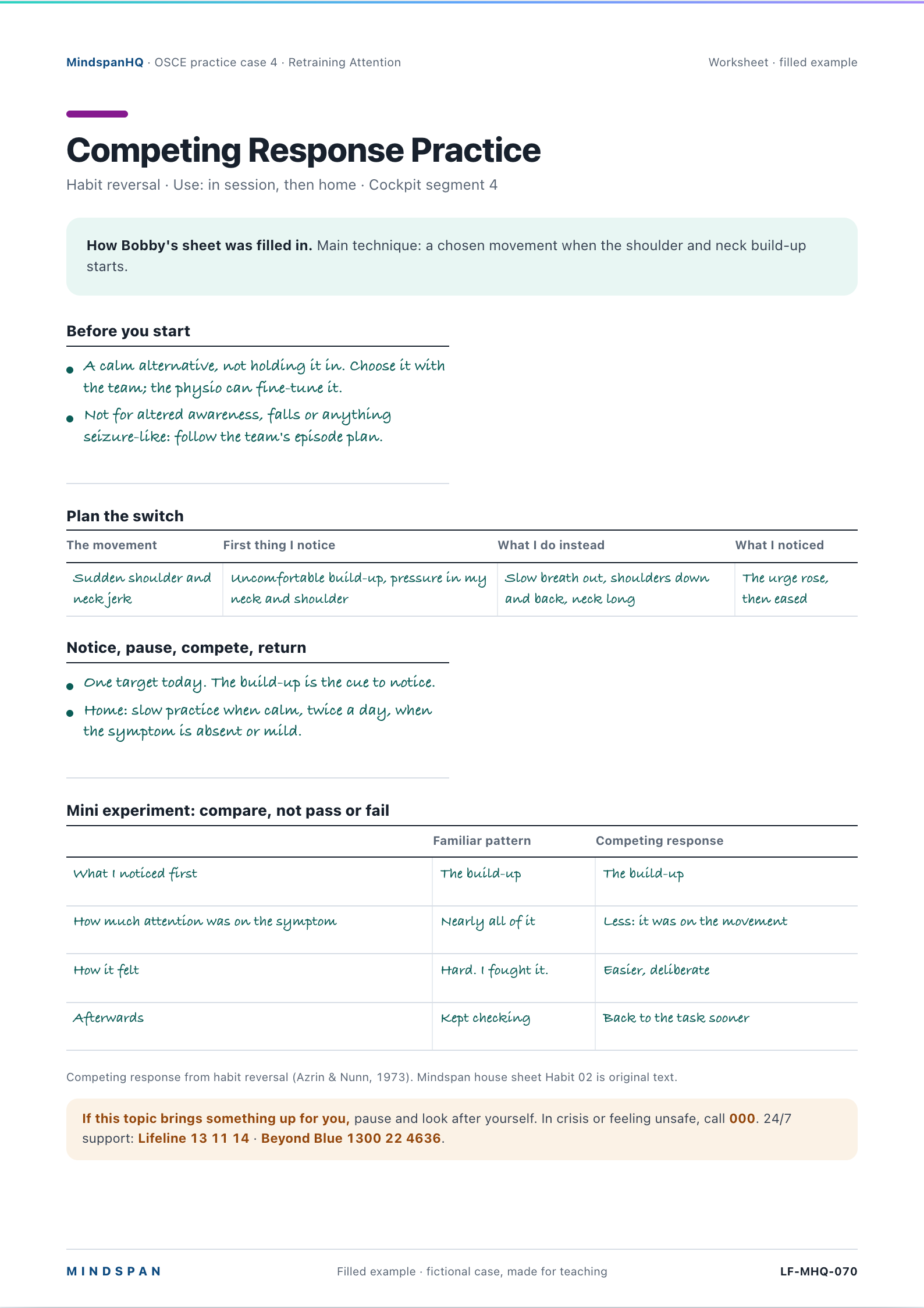 Competing Response PracticeHabit reversal Blank Filled example
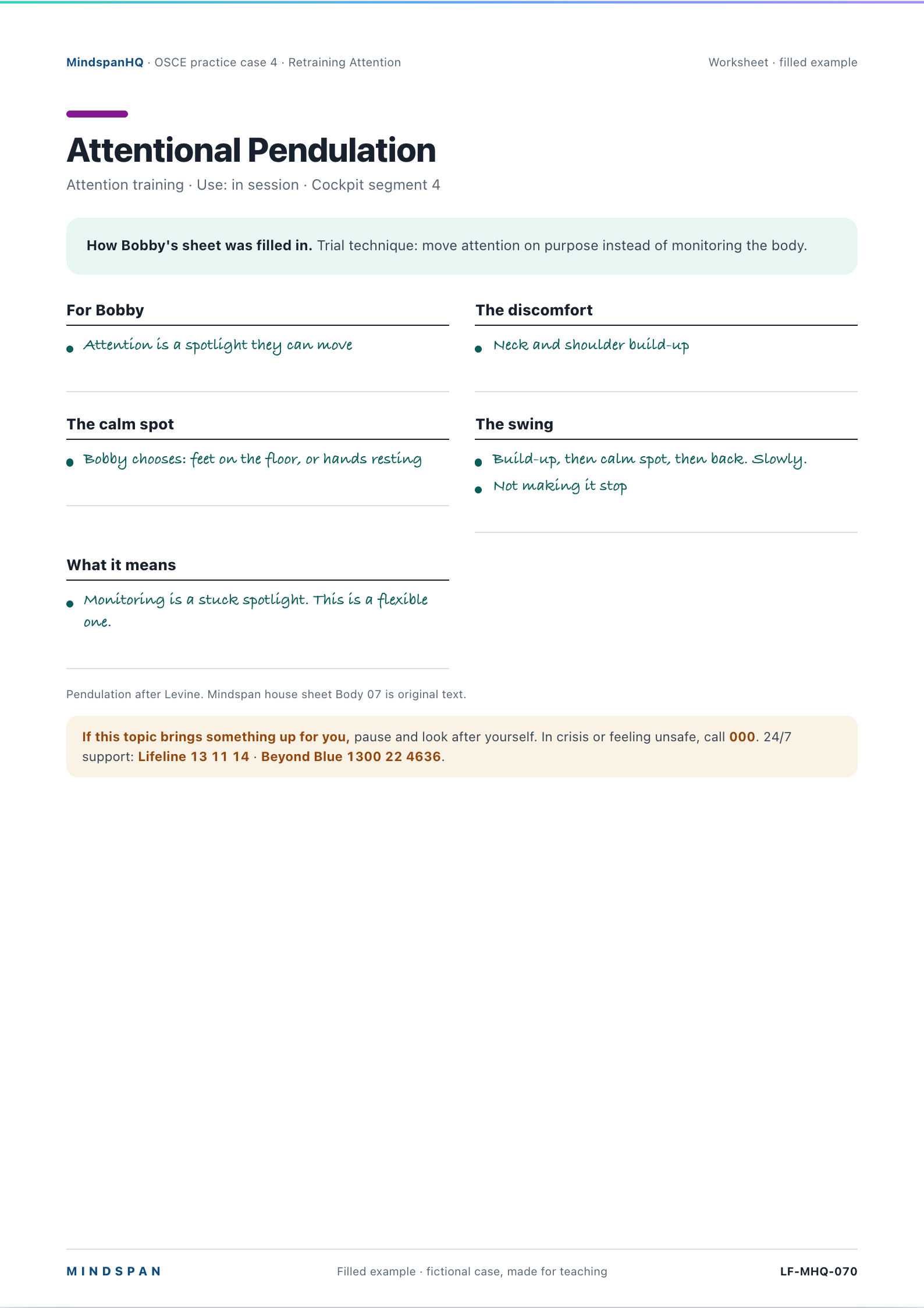 Attentional PendulationAttention training Blank Filled example
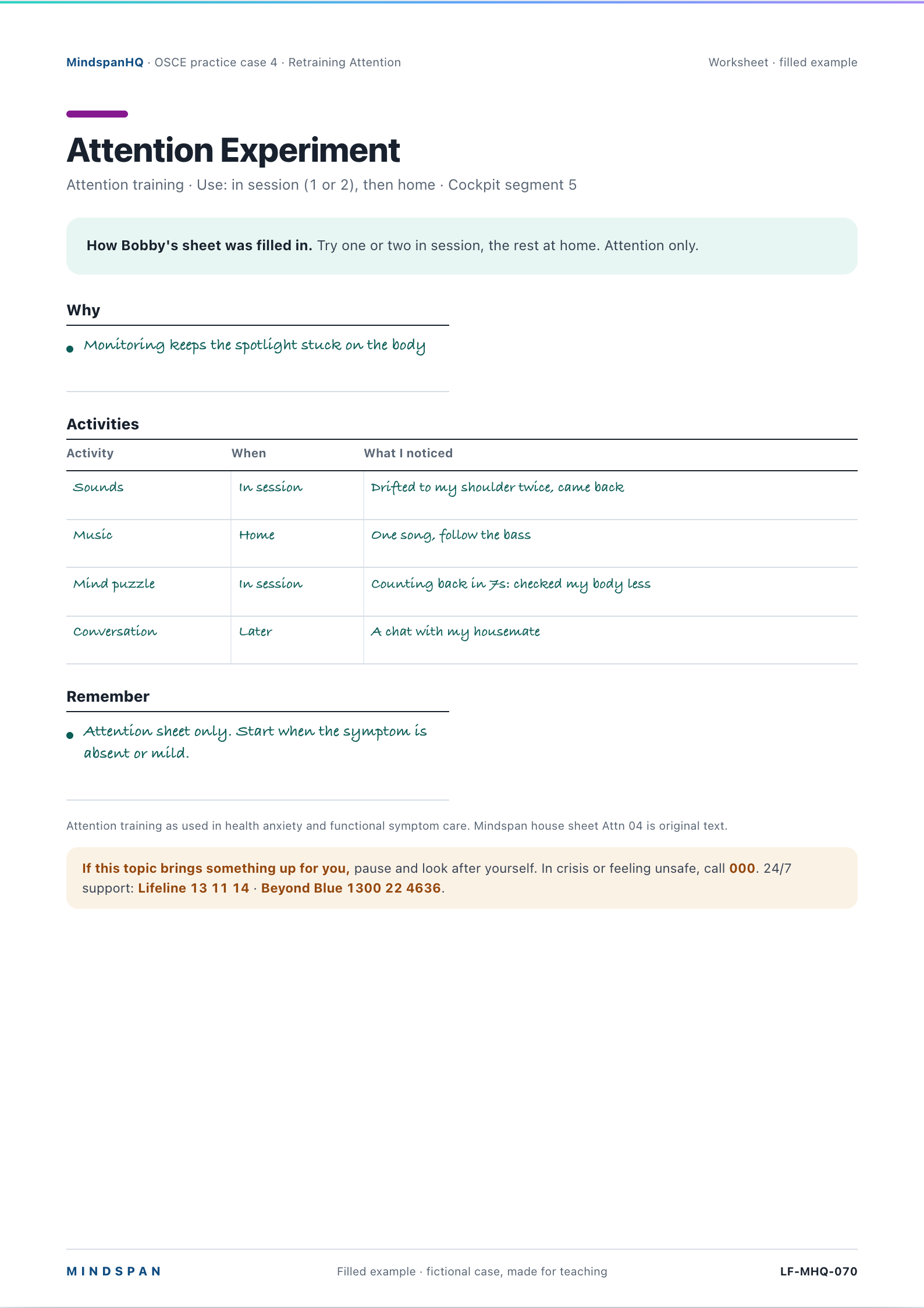 Attention ExperimentAttention training Blank Filled example
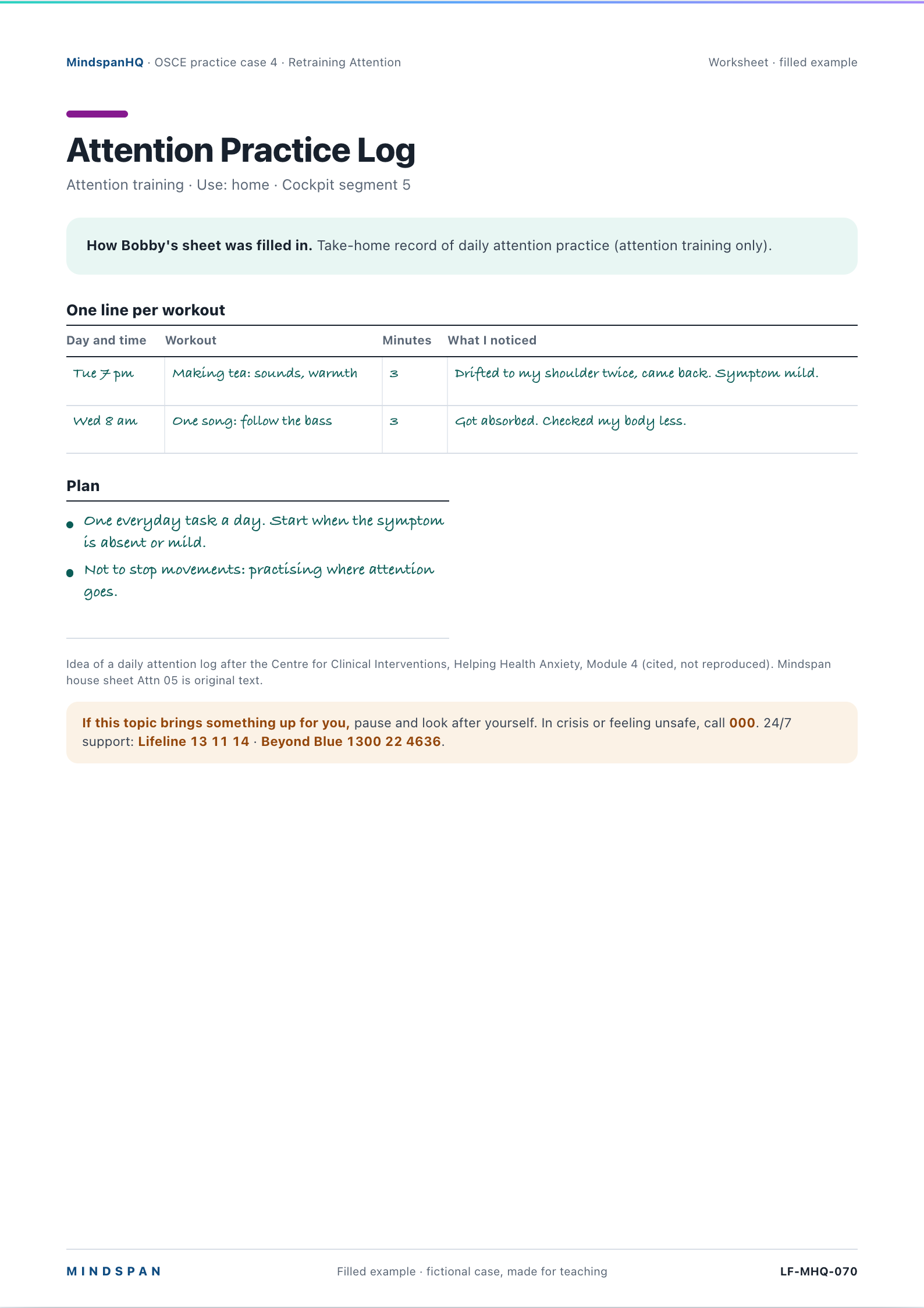 Attention Practice LogAttention training Blank Filled example
Practise with ChatGPT voice
Three steps
- Open ChatGPT (app or web) and start a new chat. Paste the whole prompt and send it as a normal text message.
- Tap the voice button (the sound-wave icon). In ChatGPT, go to Settings, then Voice, and pick a neutral, mid-range voice. Headphones stop it hearing itself.
- Set a 20-minute timer, greet Bobby and run the station. Say "End of station" to finish, then "Examiner feedback" for a debrief.
What this prompt does
- Asks ChatGPT to play Bobby, 25, a made-up client, so you can practise the psychologist's role out loud.
- Keeps the role-play in character until you say
End of station
. Then, only if you ask forExaminer feedback
, it gives a short debrief. - Contains no personal data and sends nothing anywhere. It is plain text you paste in yourself.
Practice only. Never type in real client details. It is not therapy and not clinical advice.
Go further
- Full programMindspan OSCE Psychology Exam PrepStructured preparation for the psychology OSCE. Free test-drive.
- FreeClinical health psychology previewFree. The health-formulation track this case is drawn from.
- FreeOSCE free sampleFree. A short video, an audio walkthrough and the OSCE Navigator PDF.
- In developmentCompanionIn development. Practise stations with live transcription and prompts on your own device.
- Free seriesOSCE Psychology Exam SkillsFree MindspanHQ series. This case is part 4; more practice cases and short lessons on station skills follow.
Resources mentioned
- Nielsen, G., Stone, J., Matthews, A., et al. (2015). Physiotherapy for functional motor disorders: A consensus recommendation. Journal of Neurology, Neurosurgery & Psychiatry, 86(10), 1113–1119.
- Edwards, M. J., Adams, R. A., Brown, H., Pareés, I., & Friston, K. J. (2012). A Bayesian account of 'hysteria'. Brain, 135(11), 3495–3512.
- Hallett, M., Aybek, S., Dworetzky, B. A., McWhirter, L., Staab, J. P., & Stone, J. (2022). Functional neurological disorder: New subtypes and shared mechanisms. The Lancet Neurology, 21(6), 537–550.
- Pringsheim, T., Ganos, C., McGuire, J. F., et al. (2021). Rapid onset functional tic-like behaviors in young females during the COVID-19 pandemic. Movement Disorders, 36(12), 2707–2713.
- Azrin, N. H., & Nunn, R. G. (1973). Habit-reversal: A method of eliminating nervous habits and tics. Behaviour Research and Therapy, 11(4), 619–628.
- Centre for Clinical Interventions. (n.d.). Helping Health Anxiety (Module 4). Perth: Centre for Clinical Interventions.
Take-aways
01Attention works like a spotlight.
Whatever attention lands on gets bigger and louder. Bobby scans their body for most of the day, so the spotlight sits on the symptoms. Show it in 20 seconds with a foot-in-the-shoe demonstration, then link it to their own day.
02Expectation primes the movement.
When the brain expects a movement, it starts getting ready for one. Walking into a busy café already braced for a jerk makes one more likely. That is why symptoms tend to turn up exactly where they are least wanted.
03Trying harder makes it louder.
Holding a movement in means bracing, and bracing raises tension and the build-up. Monitoring and suppression are the maintaining factors here. They make sense, and they keep the loop running. Say this without blame.
04Retraining is a different response, not more control.
The goal isn't to stop the symptom by force. It is to practise choosing where attention goes and what the body does. Bobby fears that letting go means losing control. Name that fear before any practice, and frame each technique as an experiment.
05Choose one target, trial two or three techniques.
Let Bobby pick the target. The shoulder and neck movement has a clear build-up, which gives a window to act in. Then trial two or three techniques that complement each other, and debrief each one before moving on.
06Don't re-explain the diagnosis.
Bobby already knows the symptoms are genuine and involuntary. Spending the session on that wastes it. Start from the mechanism: how attention, expectation and holding in shape the movements.
This is general mental-health education, not personal clinical advice — it is no substitute for assessment by a registered health practitioner, and discusses functional neurological symptoms. If you need support now, contact Lifeline 13 11 14, call 000 in an emergency, or speak with your GP.