Episode 69 · ~12:00
UpcomingNotes and sources are up; the episode hasn't aired yet. Subscribe to stay up to date.
OSCE Practice Case: ACT After Cancer, Willingness Before Certainty.
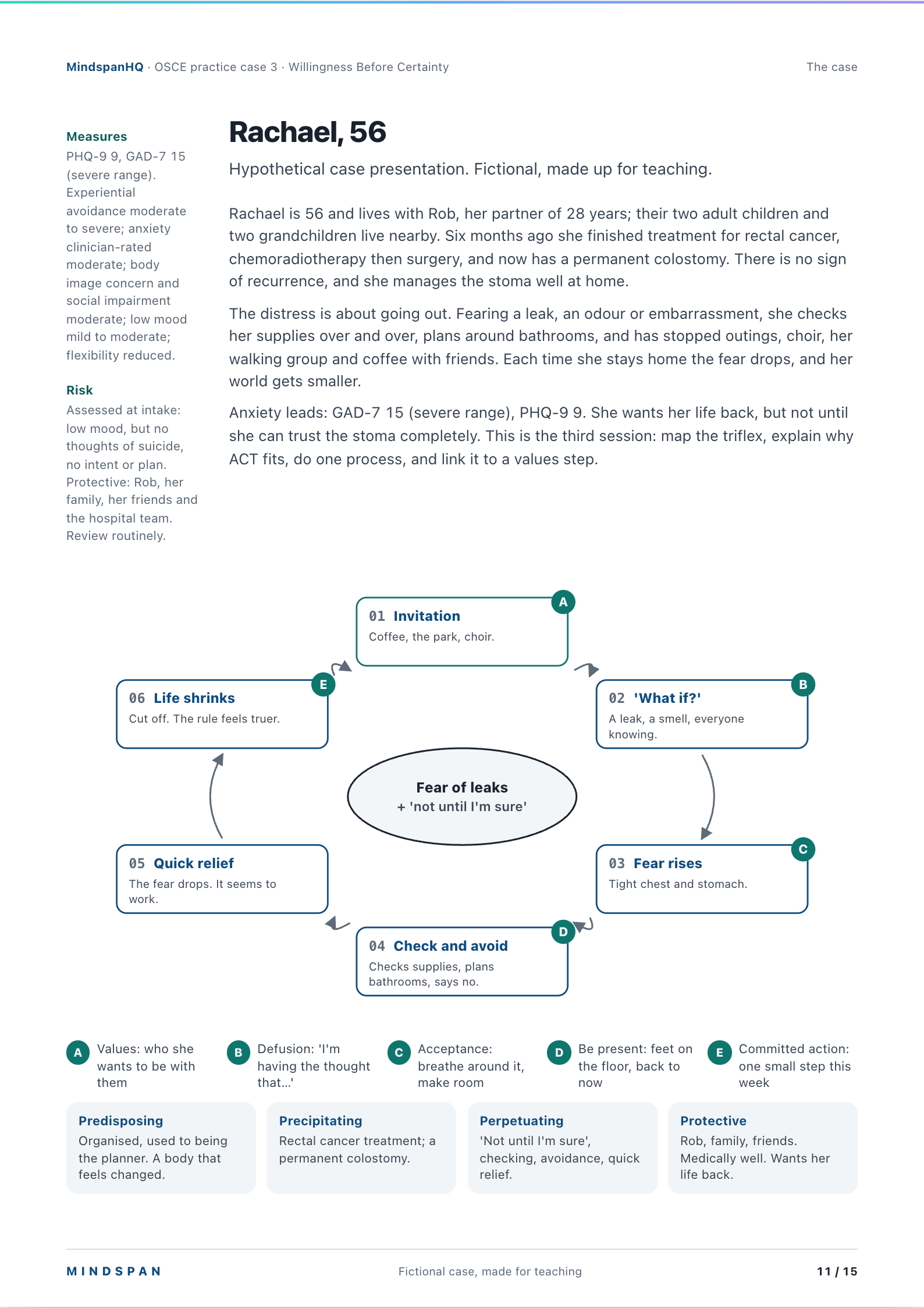
"A simulated OSCE station with an AI patient: Rachael, 56, finished treatment for bowel cancer six months ago and now lives with a permanent colostomy. She is coping well medically, but fear of leaks and embarrassment keeps her at home, and she says she can't get her life back until she can trust it completely. Watch an ACT formulation, one process done experientially and a values-linked step, then run the same station yourself with the free prompt and study pack."
Run this station yourself
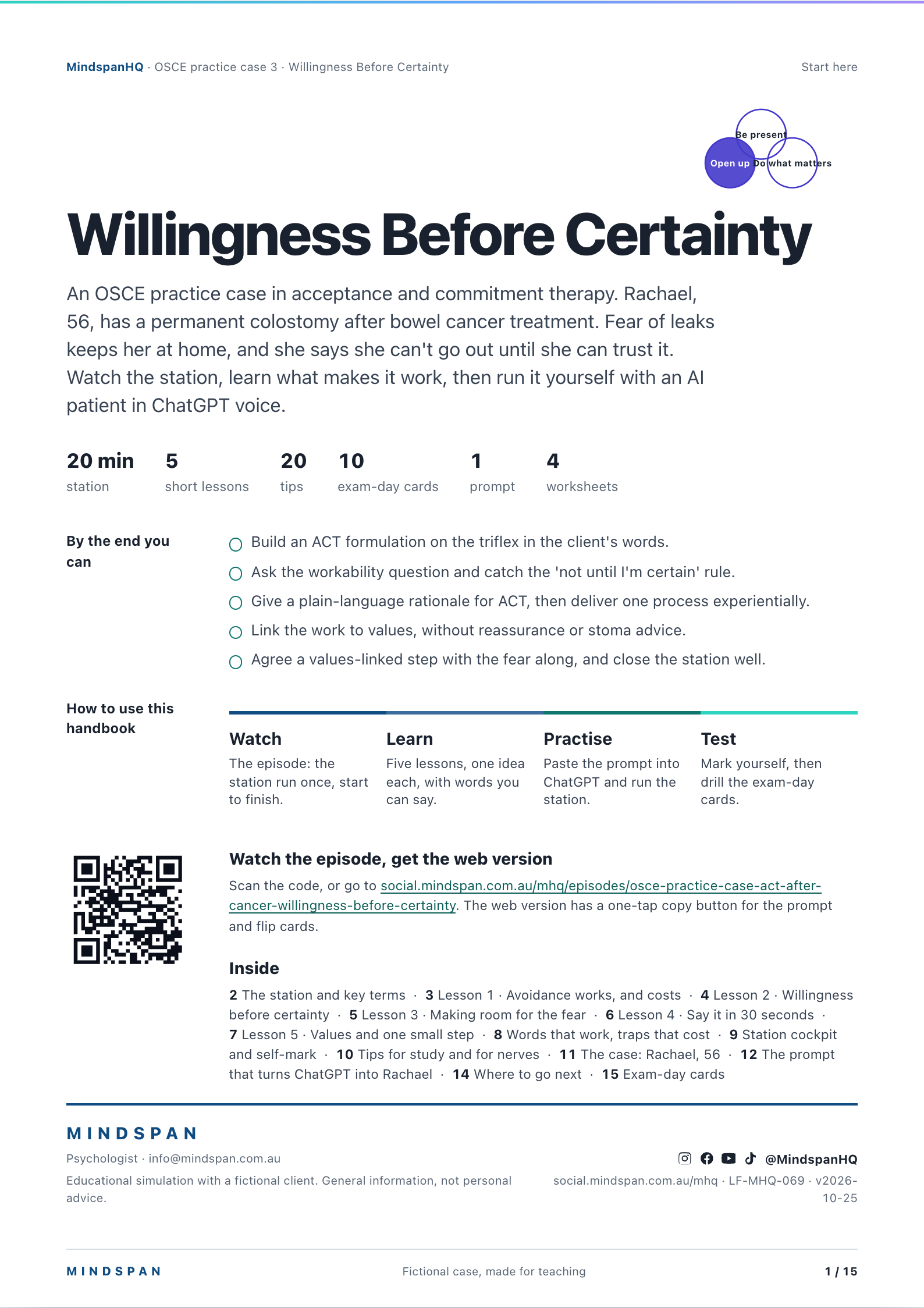
The free handbook behind the episode: 15 pages, the exact ChatGPT voice prompt, no sign-up.
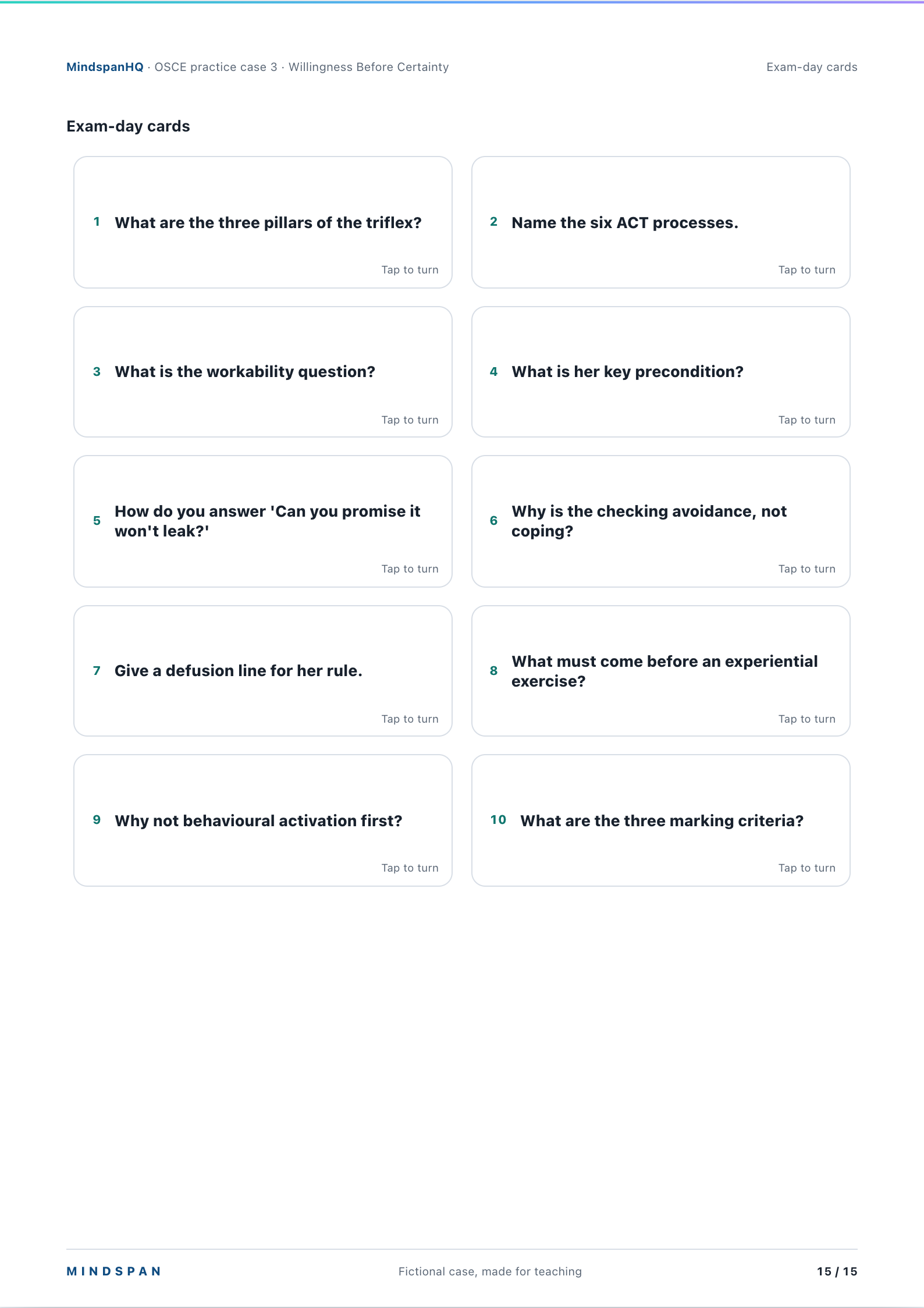
- Study notes: workability, defusion, making room, values, phrase bank
- The station cockpit: segments, example lines, rubric self-mark
- 10 study tips + 10 tips for exam nerves
- 4 worksheets, blank and filled in
- The case and its clinical map
- The ChatGPT voice prompt
Sheets for this station
Free to download and print. Each worksheet comes blank, with room to write, and filled in as Rachael would fill it in.
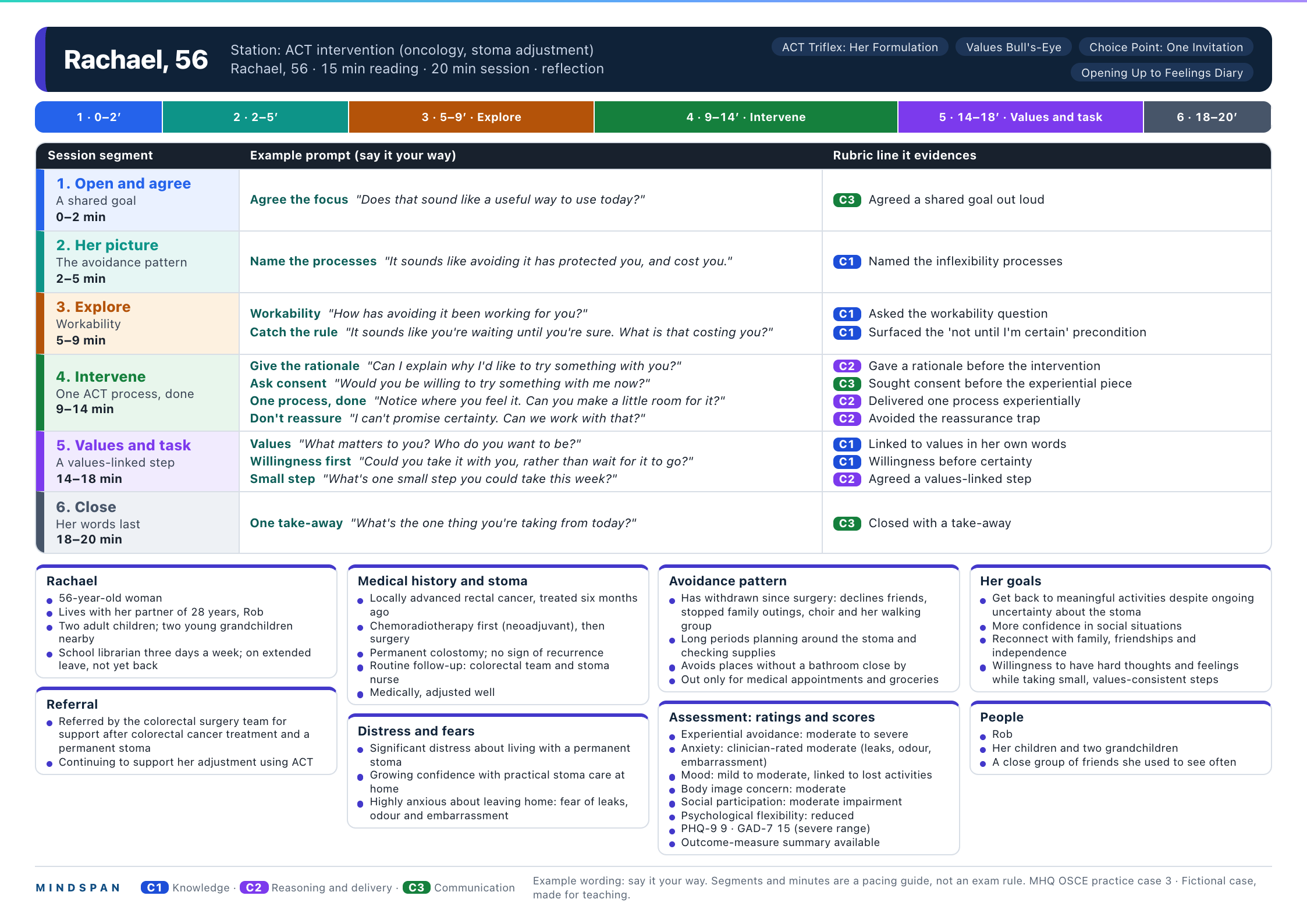 Station cockpitThe whole station on one landscape page: six segments, an example line for each move, and the rubric line it evidences. Download the cockpit
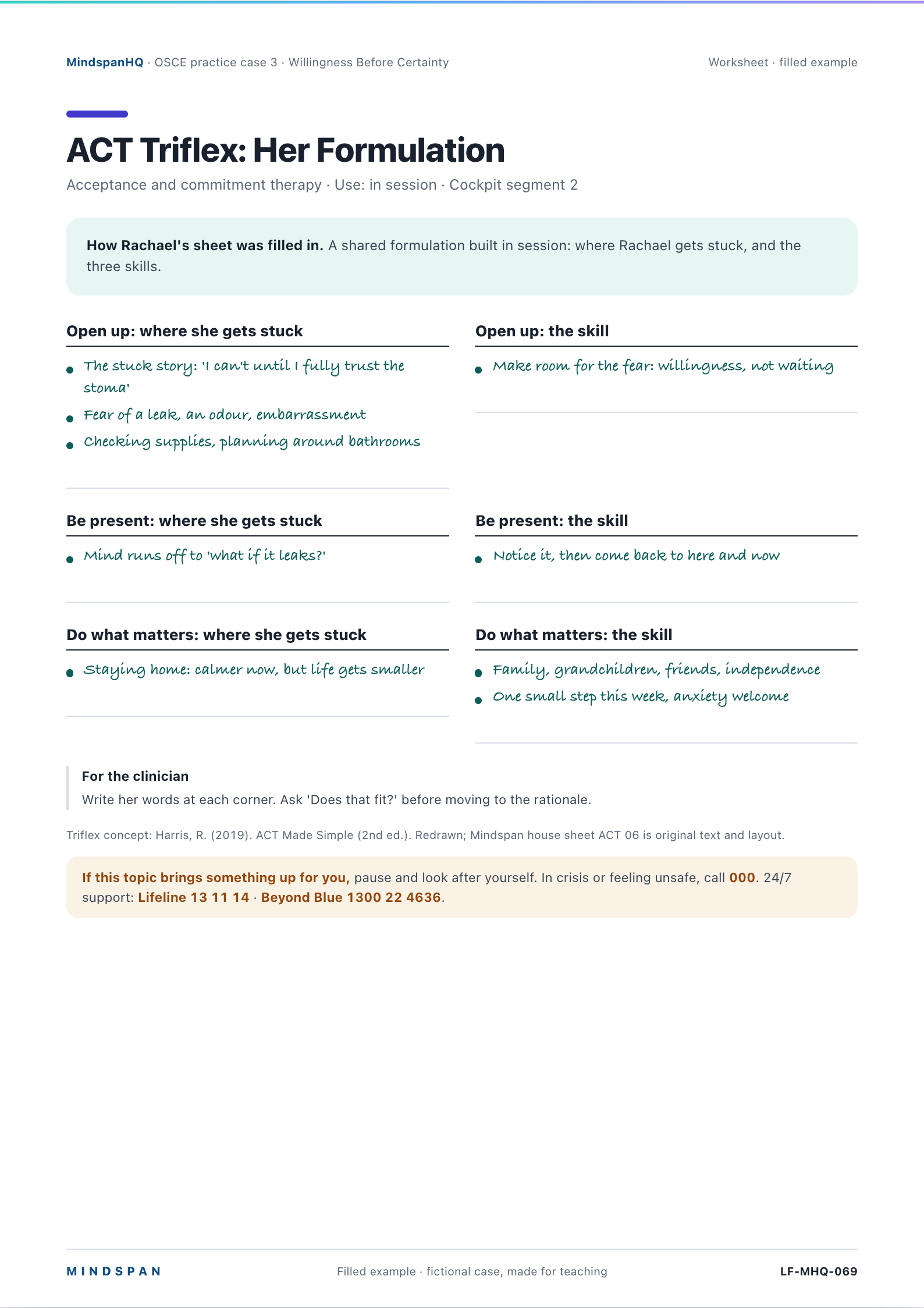 ACT Triflex: Her FormulationAcceptance and commitment therapy Blank Filled example
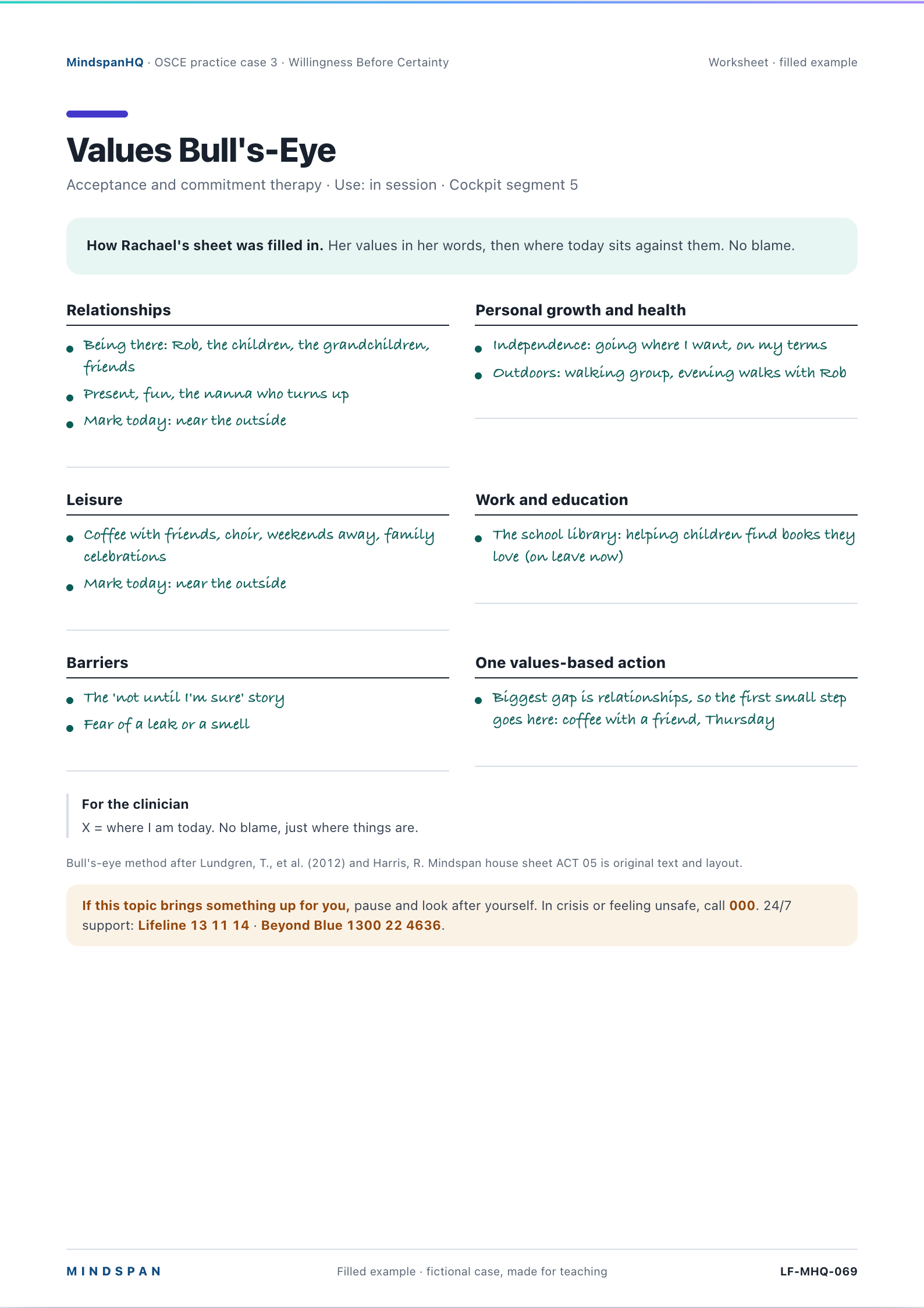 Values Bull's-EyeAcceptance and commitment therapy Blank Filled example
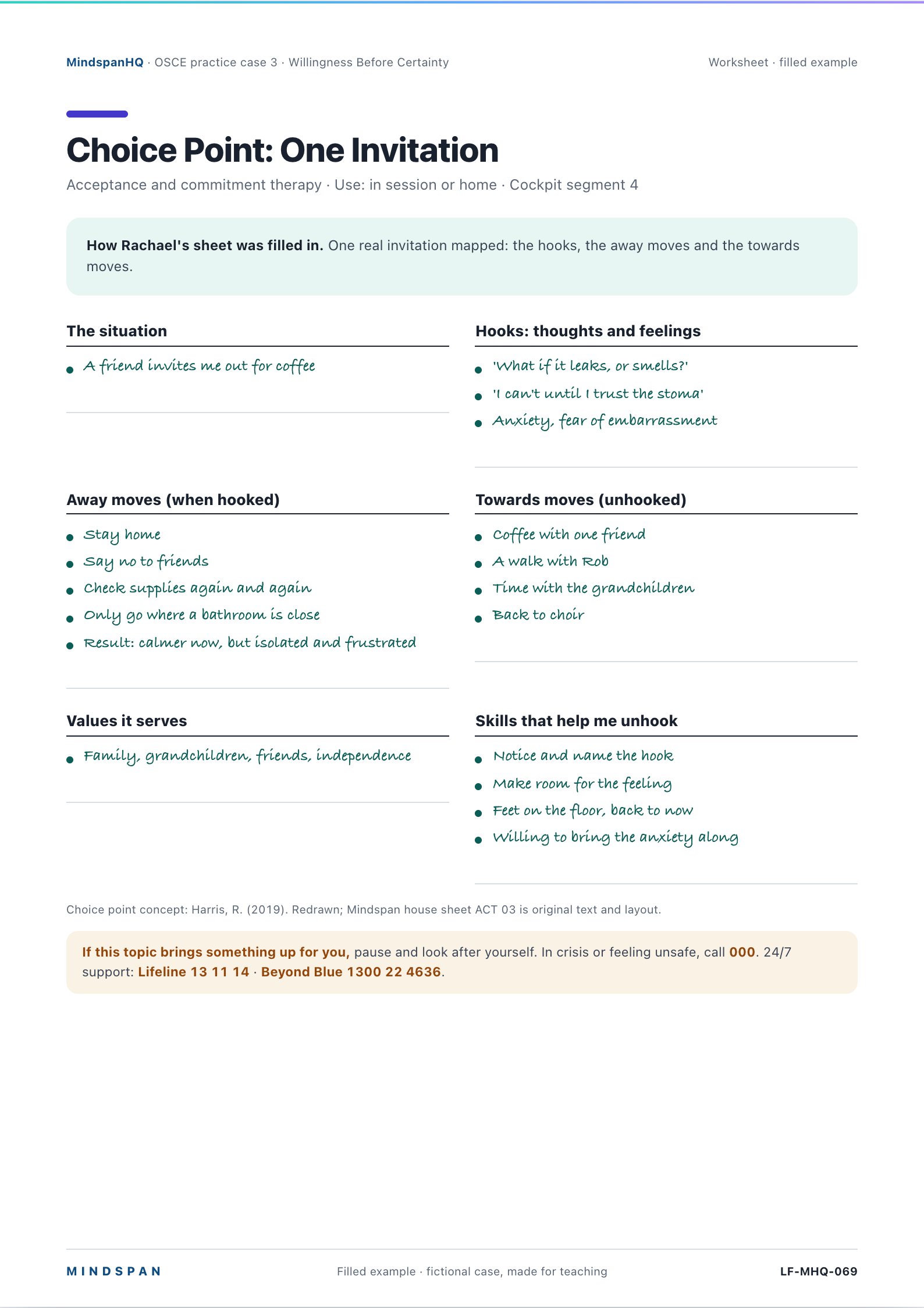 Choice Point: One InvitationAcceptance and commitment therapy Blank Filled example
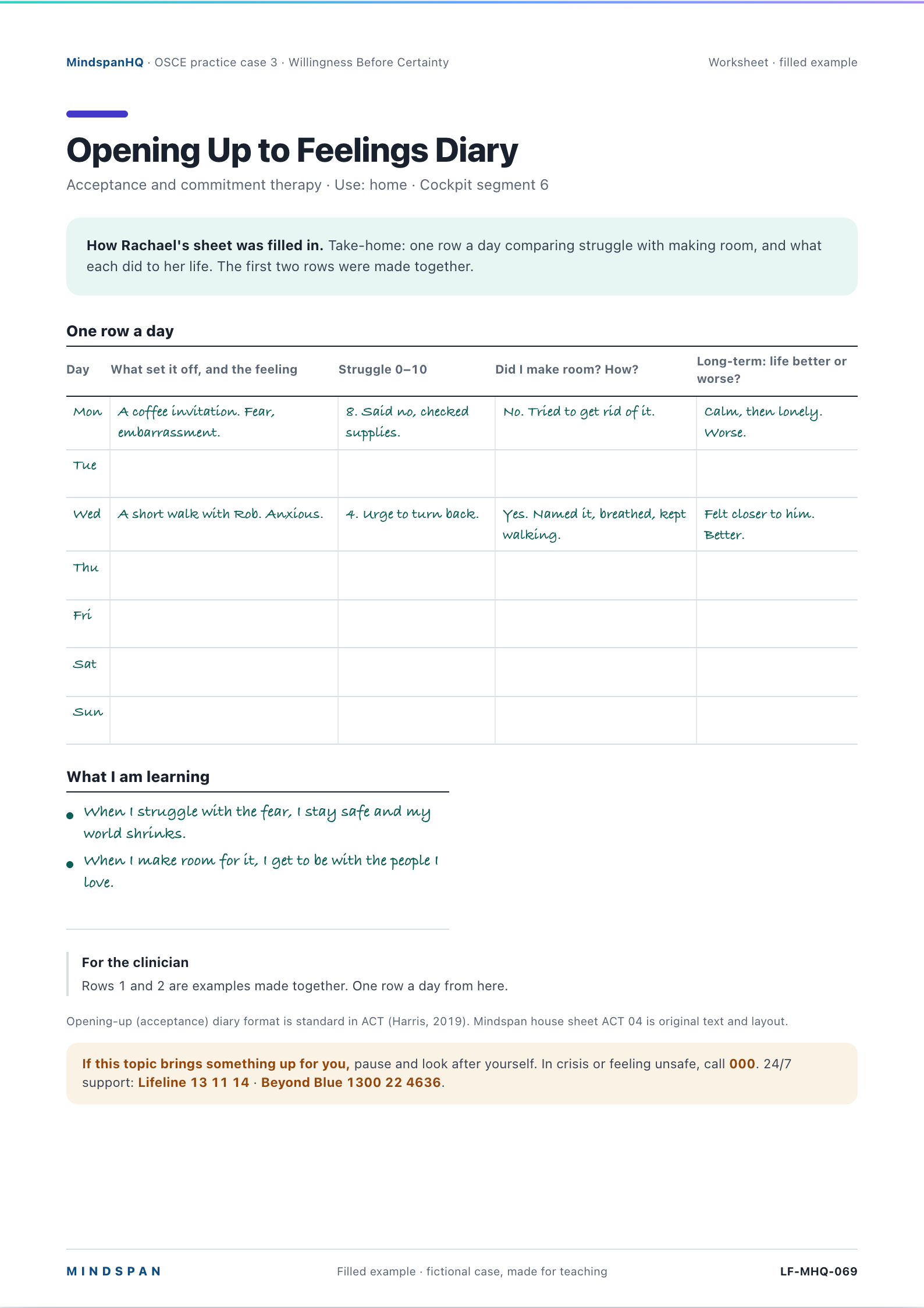 Opening Up to Feelings DiaryAcceptance and commitment therapy Blank Filled example
Practise with ChatGPT voice
Three steps
- Open ChatGPT (app or web) and start a new chat. Paste the whole prompt and send it as a normal text message.
- Tap the voice button (the sound-wave icon). In ChatGPT, go to Settings, then Voice, and pick a warm, middle-aged female-sounding voice. Headphones stop it hearing itself.
- Set a 20-minute timer, greet Rachael and run the station. Say "End of station" to finish, then "Examiner feedback" for a debrief.
What this prompt does
- Asks ChatGPT to play Rachael, 56, a made-up client, so you can practise the psychologist's role out loud.
- Keeps the role-play in character until you say
End of station
. Then, only if you ask forExaminer feedback
, it gives a short debrief. - Contains no personal data and sends nothing anywhere. It is plain text you paste in yourself.
Practice only. Never type in real client details. It is not therapy and not clinical advice.
Go further
- Full programMindspan OSCE Psychology Exam PrepStructured preparation for the psychology OSCE. Free test-drive.
- FreeClinical health psychology previewFree. The health-formulation track this case is drawn from.
- FreeOSCE free sampleFree. A short video, an audio walkthrough and the OSCE Navigator PDF.
- In developmentCompanionIn development. Practise stations with live transcription and prompts on your own device.
- Free seriesOSCE Psychology Exam SkillsFree MindspanHQ series. This case is part 3; more practice cases and short lessons on station skills follow.
Resources mentioned
- Hayes, S. C., Strosahl, K. D., & Wilson, K. G. (2012). Acceptance and Commitment Therapy: The Process and Practice of Mindful Change (2nd ed.). Guilford Press.
- Harris, R. (2019). ACT Made Simple: An Easy-to-Read Primer on Acceptance and Commitment Therapy (2nd ed.). New Harbinger.
- Lundgren, T., Luoma, J. B., Dahl, J., Strosahl, K., & Melin, L. (2012). The Bull's-Eye Values Survey: A psychometric evaluation. Cognitive and Behavioral Practice, 19(4), 518–526.
- Hulbert-Williams, N. J., Storey, L., & Wilson, K. G. (2015). Psychological interventions for patients with cancer: Psychological flexibility and the potential utility of Acceptance and Commitment Therapy. European Journal of Cancer Care, 24(1), 15–27.
- Sharpe, L., Patel, D., & Clarke, S. (2011). The relationship between body image disturbance and distress in colorectal cancer patients with and without stomas. Journal of Psychosomatic Research, 70(5), 395–402.
- Graham, C. D., Gouick, J., Krahé, C., & Gillanders, D. (2016). A systematic review of the use of Acceptance and Commitment Therapy (ACT) in chronic disease and long-term conditions. Clinical Psychology Review, 46, 46–58.
Take-aways
01Avoidance works, and that is the trap.
Saying no, checking supplies and staying near a bathroom lower her anxiety straight away. That relief is real. Over six months the same moves have cut her off from family, friends and the things she loves. Ask about short-term relief and long-term cost; don't argue with the strategies.
02The rule is the hook.
Her mind says she can't get her life back until she can trust the stoma completely. That rule turns certainty into a gate. No one can promise certainty, so life keeps waiting. The ACT target is her relationship with the rule, not the stoma.
03Willingness before certainty.
Willingness means making room for fear and doubt in order to do what matters. It isn't liking the fear or giving up. The feeling doesn't have to leave first. She can take it with her.
04Three pillars: be present, open up, do what matters.
The triflex groups the six ACT processes. Be present: contact with now and the noticing self. Open up: acceptance and defusion. Do what matters: values and committed action. Map her pattern onto all three, then deliver one process properly.
05Experiential, not explained.
Do the skill with her in the room: say the rule with 'I'm having the thought that…', or breathe around the fear. Ask consent first, offer a stop at any point, and debrief what she noticed.
06Stay in your lane.
Practical stoma questions belong with her stoma nurse. Don't problem-solve the bag, and don't reassure her about leaks or the cancer. Your work is how she carries the fear while she moves towards her values.
This is general mental-health education, not personal clinical advice — it is no substitute for assessment by a registered health practitioner, and discusses cancer, living with a stoma and anxiety. If you need support now, contact Lifeline 13 11 14, call 000 in an emergency, or speak with your GP.