Episode 68 · ~12:00
UpcomingNotes and sources are up; the episode hasn't aired yet. Subscribe to stay up to date.
OSCE Practice Case: Motivational Interviewing for Moving More.
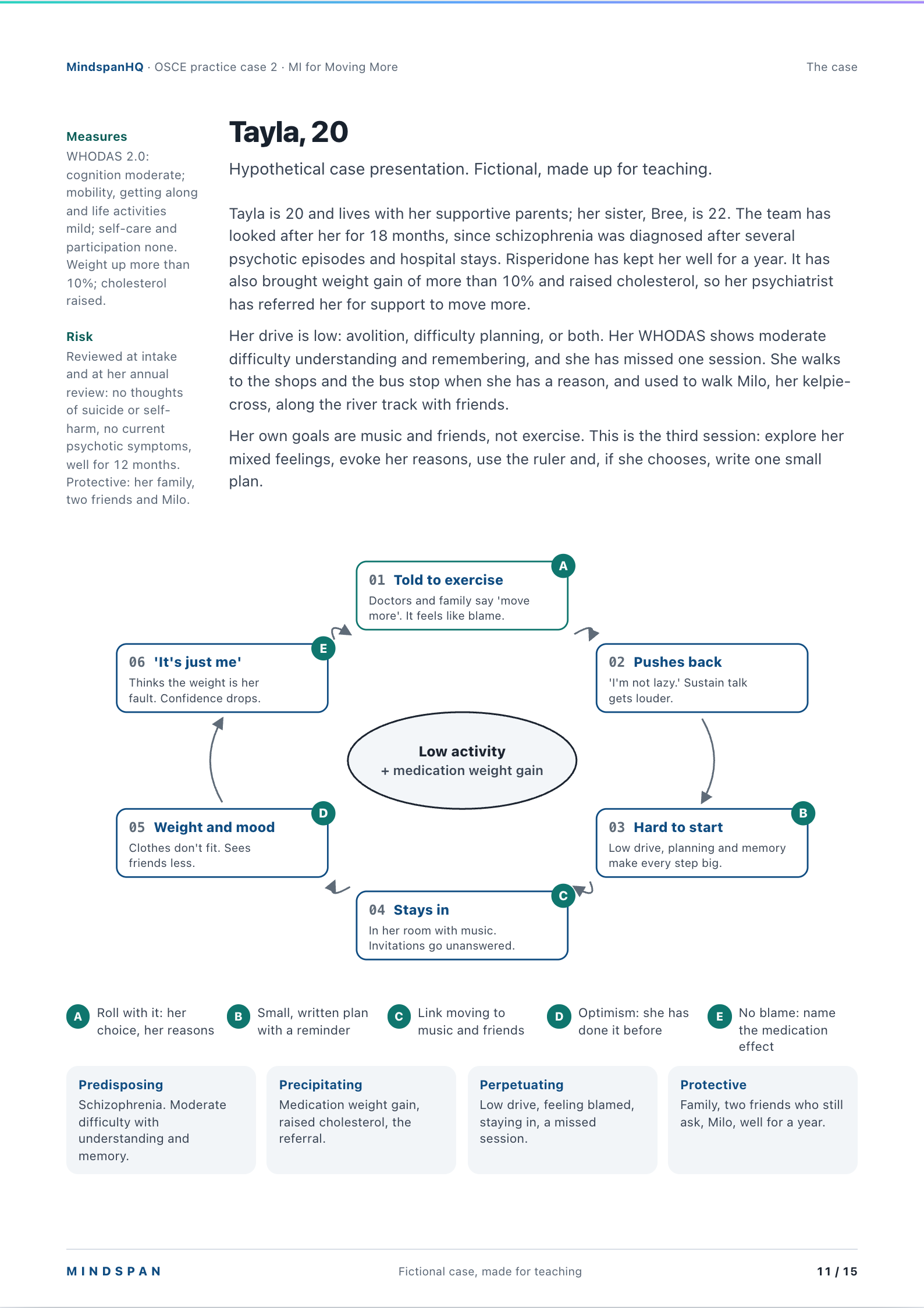
"A simulated OSCE station with an AI patient: Tayla, 20, has schizophrenia that has been stable for a year, and her medication has brought weight gain and raised cholesterol. Her psychiatrist wants her moving more; she wants more music and more time with friends. Watch change talk evoked, a readiness ruler used and a small plan written in her words, then run the same station yourself with the free prompt and study pack."
Run this station yourself
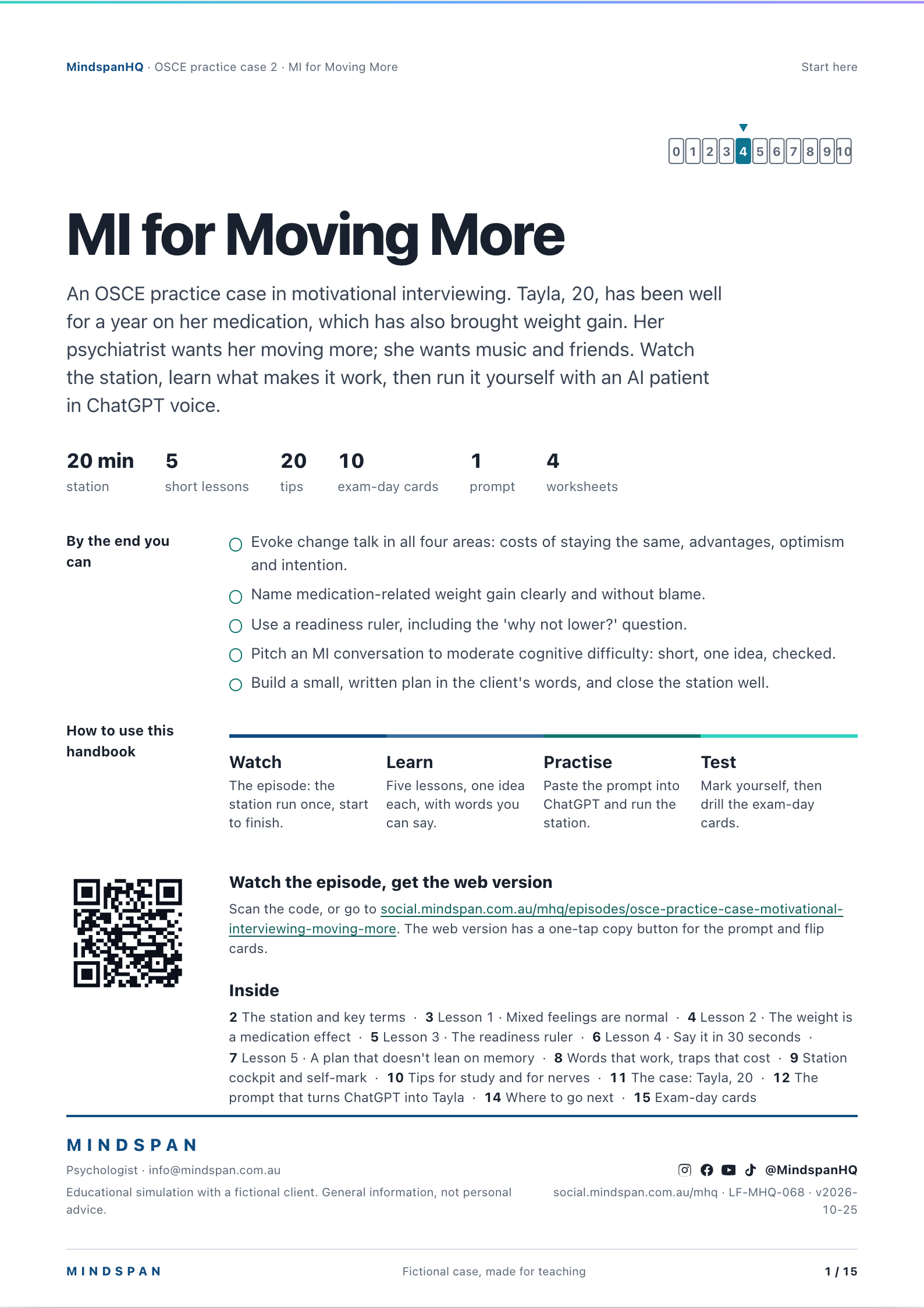
The free handbook behind the episode: 15 pages, the exact ChatGPT voice prompt, no sign-up.
- Study notes: mixed feelings, no-blame framing, the readiness ruler, phrase bank
- The station cockpit: segments, example lines, rubric self-mark
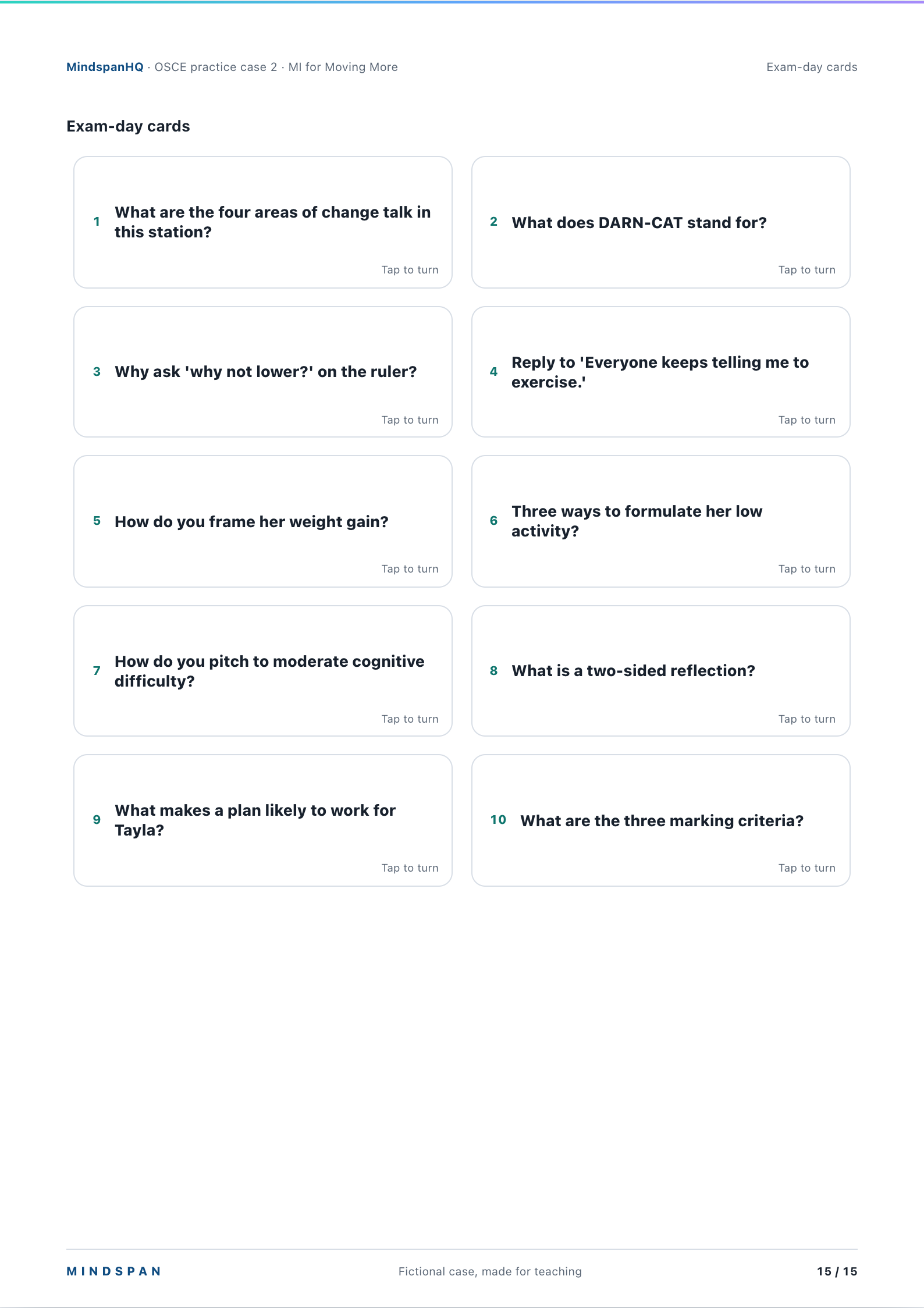
- 10 study tips + 10 tips for exam nerves
- 4 worksheets, blank and filled in
- The case and its clinical map
- The ChatGPT voice prompt
Sheets for this station
Free to download and print. Each worksheet comes blank, with room to write, and filled in as Tayla would fill it in.
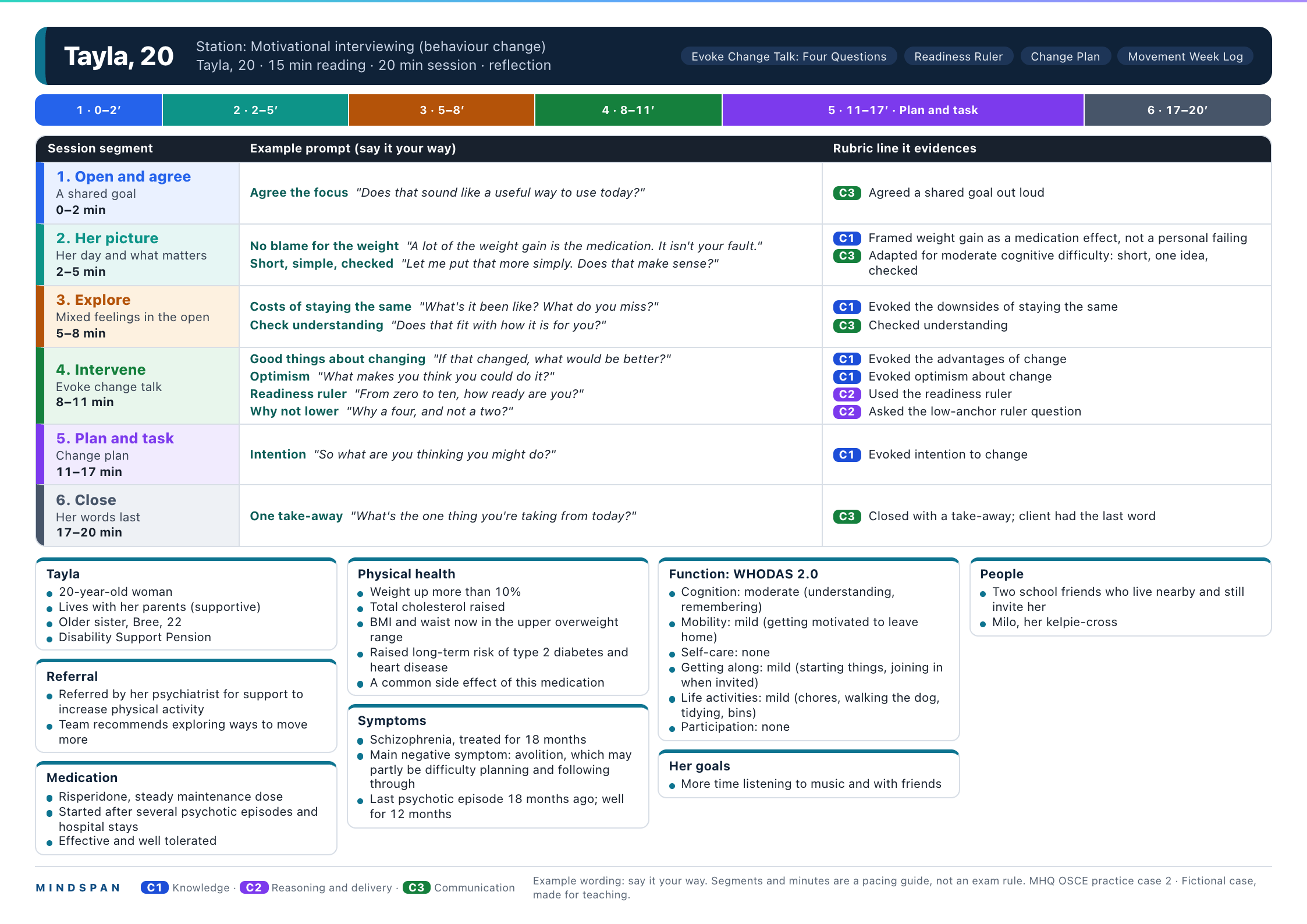 Station cockpitThe whole station on one landscape page: six segments, an example line for each move, and the rubric line it evidences. Download the cockpit
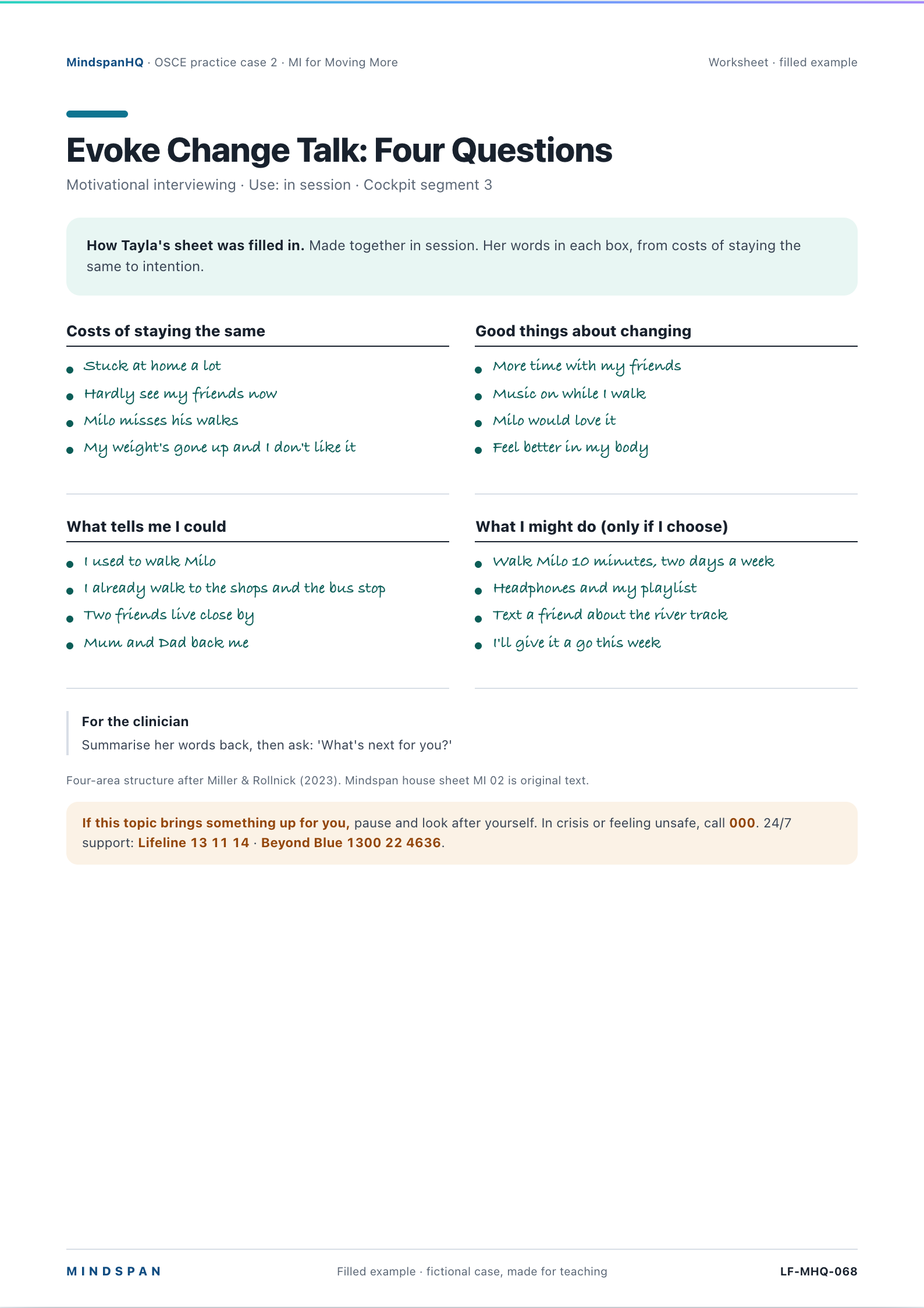 Evoke Change Talk: Four QuestionsMotivational interviewing Blank Filled example
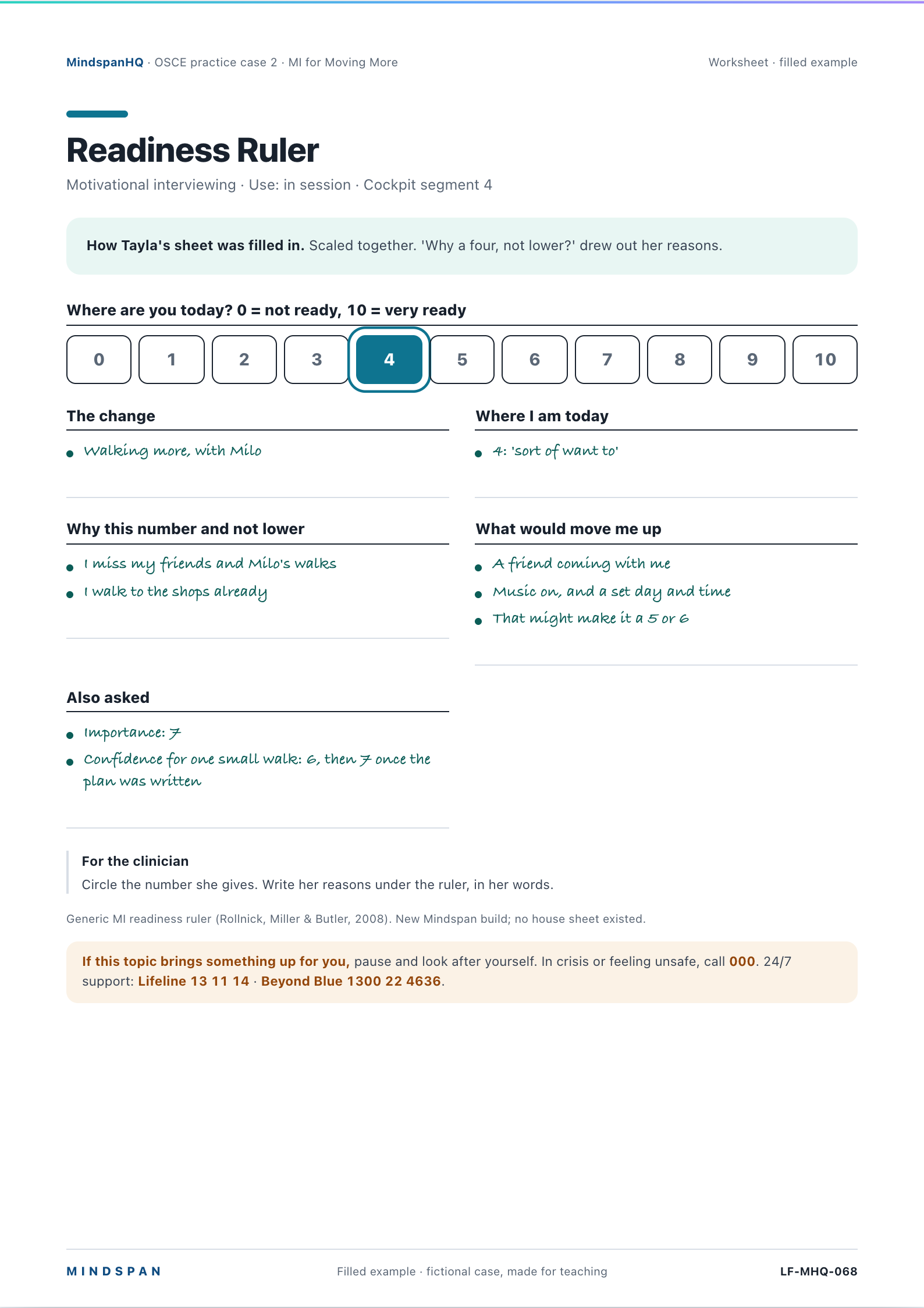 Readiness RulerMotivational interviewing Blank Filled example
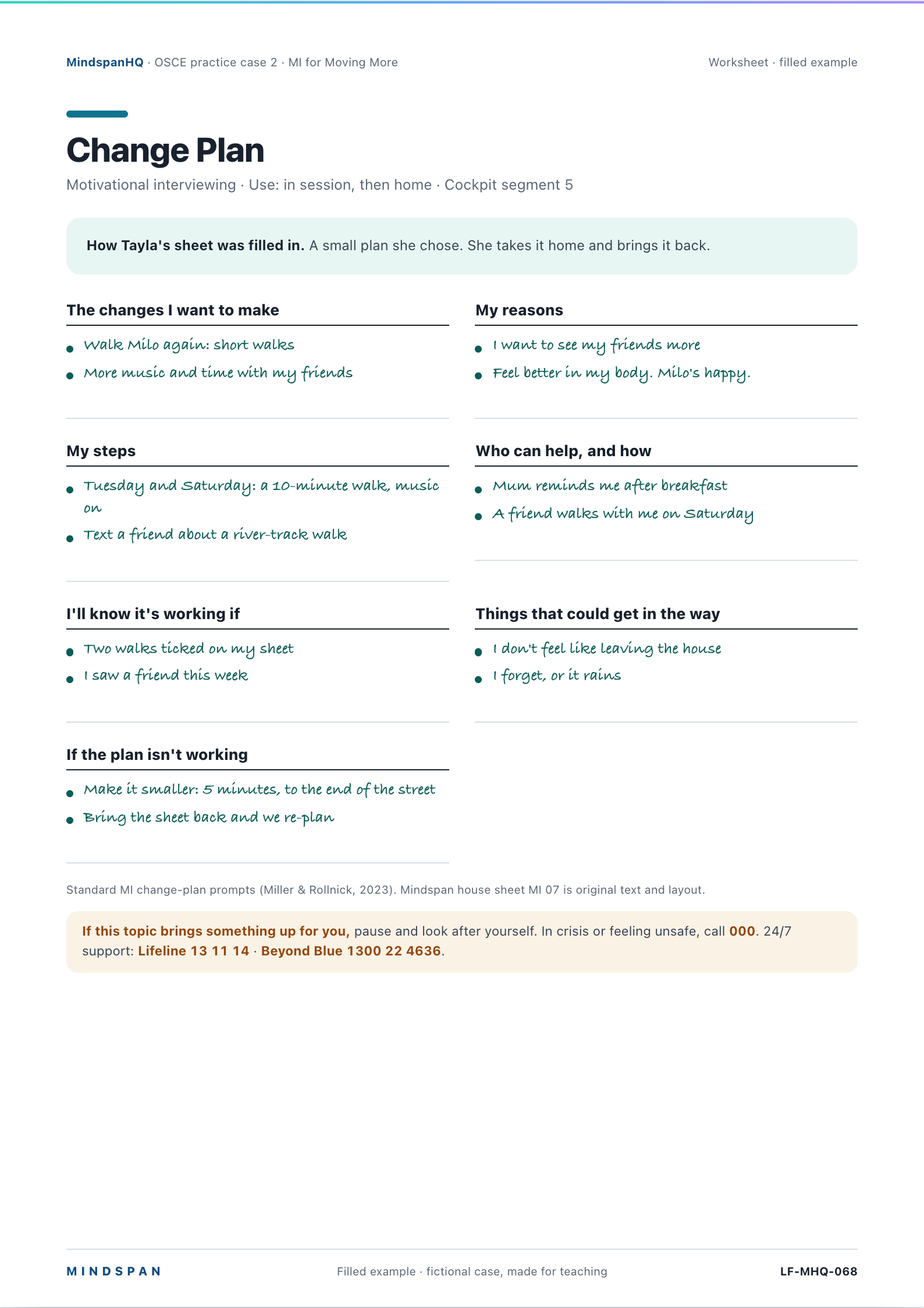 Change PlanMotivational interviewing Blank Filled example
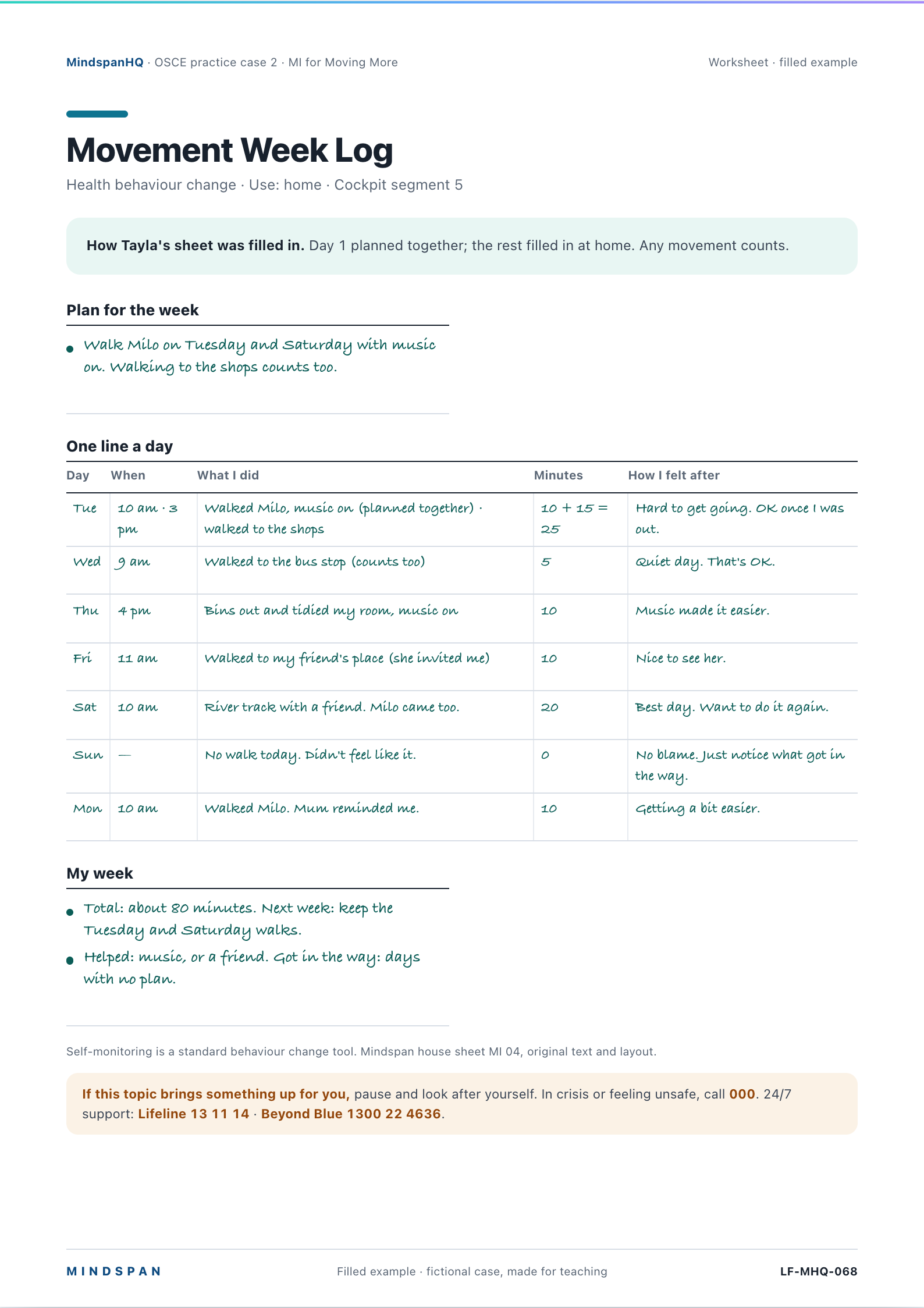 Movement Week LogHealth behaviour change Blank Filled example
Practise with ChatGPT voice
Three steps
- Open ChatGPT (app or web) and start a new chat. Paste the whole prompt and send it as a normal text message.
- Tap the voice button (the sound-wave icon). In ChatGPT, go to Settings, then Voice, and pick a younger, softer female-sounding voice. Headphones stop it hearing itself.
- Set a 20-minute timer, greet Tayla and run the station. Say "End of station" to finish, then "Examiner feedback" for a debrief.
What this prompt does
- Asks ChatGPT to play Tayla, 20, a made-up client, so you can practise the psychologist's role out loud.
- Keeps the role-play in character until you say
End of station
. Then, only if you ask forExaminer feedback
, it gives a short debrief. - Contains no personal data and sends nothing anywhere. It is plain text you paste in yourself.
Practice only. Never type in real client details. It is not therapy and not clinical advice.
Go further
- Full programMindspan OSCE Psychology Exam PrepStructured preparation for the psychology OSCE. Free test-drive.
- FreeClinical health psychology previewFree. The health-formulation track this case is drawn from.
- FreeOSCE free sampleFree. A short video, an audio walkthrough and the OSCE Navigator PDF.
- In developmentCompanionIn development. Practise stations with live transcription and prompts on your own device.
- Free seriesOSCE Psychology Exam SkillsFree MindspanHQ series. This case is part 2; more practice cases and short lessons on station skills follow.
Resources mentioned
- Miller, W. R., & Rollnick, S. (2023). Motivational Interviewing: Helping People Change and Grow (4th ed.). Guilford Press.
- Rollnick, S., Miller, W. R., & Butler, C. C. (2008). Motivational Interviewing in Health Care: Helping Patients Change Behavior. Guilford Press.
- Firth, J., et al. (2019). The Lancet Psychiatry Commission: A blueprint for protecting physical health in people with mental illness. The Lancet Psychiatry, 6(8), 675–712.
- Curtis, J., Watkins, A., Rosenbaum, S., et al. (2016). Evaluating an individualized lifestyle and life skills intervention to prevent antipsychotic-induced weight gain in first-episode psychosis. Early Intervention in Psychiatry, 10(3), 267–276.
- Galletly, C., et al. (2016). Royal Australian and New Zealand College of Psychiatrists clinical practice guidelines for the management of schizophrenia and related disorders. Australian & New Zealand Journal of Psychiatry, 50(5), 410–472.
- Rosenbaum, S., Tiedemann, A., Sherrington, C., Curtis, J., & Ward, P. B. (2014). Physical activity interventions for people with mental illness: A systematic review and meta-analysis. Journal of Clinical Psychiatry, 75(9), 964–974.
Take-aways
01Mixed feelings are normal, not resistance.
Part of her wants to move more and part of her doesn't. Both make sense. If you argue for change, she will argue against it. Your job is to help her hear her own reasons, in her own words.
02The weight is a medication effect, not a failing.
Weight gain and raised cholesterol are common with antipsychotic medication. The same medication has kept her well for a year. Say both clearly and without blame, and leave every medication question to her psychiatrist.
03Evoke change talk in four areas.
The costs of staying the same, the good things about changing, her optimism that she could, and her intention. Ask, reflect, and write it down in her words. She talks herself towards change; you don't do it for her.
04Low drive, mixed feelings or hard to plan?.
Avolition, ambivalence and difficulty planning look the same from the outside. MI works on the mixed feelings. Structure works on the planning: a small, written plan with a reminder, so it doesn't lean on memory.
05Pitch it to her.
Her WHODAS shows moderate difficulty understanding and remembering. Use short sentences, one idea at a time, then check. If she looks away, slow down and shrink the message.
06Bridge her goals and the referral.
The referral says physical activity. She says music and friends. Don't override hers. Ask how moving might fit with what she already wants, such as music on a walk, or walking to a friend's place.
This is general mental-health education, not personal clinical advice — it is no substitute for assessment by a registered health practitioner, and discusses serious mental illness and physical health. If you need support now, contact Lifeline 13 11 14, call 000 in an emergency, or speak with your GP.